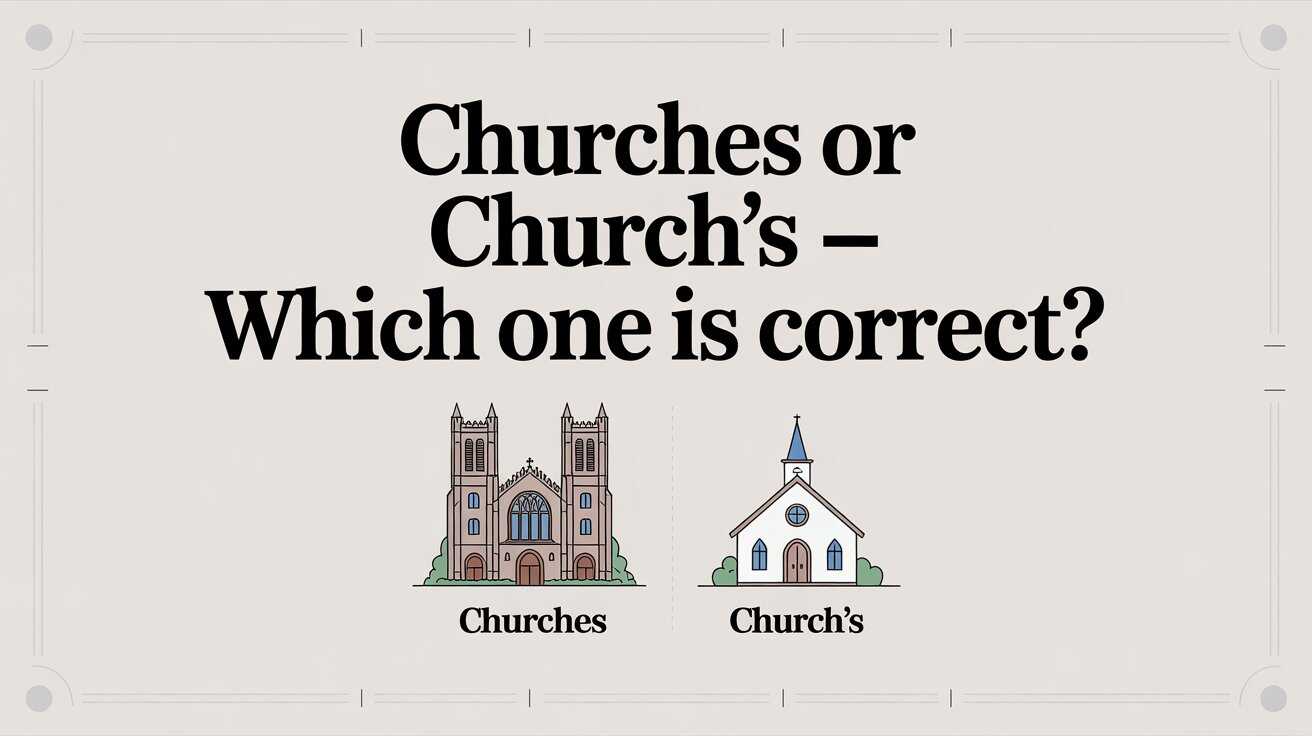
Churches or Church’s is a common grammar question that confuses many students, writers, and ESL learners. People often ask, “is it churches or church’s?” The answer depends on whether you are talking about more than one church or something belonging to a church. Understanding the difference between churches and church’s is essential for proper writing. In this article, we will explore the rules, examples, pronunciation, and common mistakes so that you can confidently use these forms in your writing.
Quick Answer — Is It Churches or Church’s?
When asked is it churches or church’s, the short answer is: both are correct, but used differently. Churches is the plural form, used when referring to multiple buildings or congregations. Church’s is the singular possessive, used when something belongs to one church. Choosing the correct form depends on context, and using the wrong one can make your writing seem unprofessional or confusing.
Difference Between Churches and Church’s
The unmistakable difference between churches and church’s lies in grammar and meaning. The table below summarizes this clearly:
| Form | Correct? | Meaning | Example Sentence |
|---|---|---|---|
| Churches | ✅ Yes | More than one church | The city has many churches. |
| Church’s | ✅ Yes | Belonging to a single church | The church’s roof needs repair. |
Fact: Many writers confuse these because they sound similar when spoken, but the apostrophe in church’s is what indicates possession.
When to Use Churches
Churches is simply the plural form of church, used to describe more than one church building or organization. For example, a sentence like “The town has five churches within walking distance” uses the plural correctly. You also use churches when discussing multiple congregations, denominations, or groups.
Tip: Remember that plural nouns in English typically add -s or -es. Since “church” ends with -ch, the plural form is churches. This applies to other words like bench → benches or watch → watches.
When to Use Church’s
The form church’s is the singular possessive. You use it when something belongs to one church, such as its roof, choir, or congregation. Examples include:
- The church’s bell rang loudly during the morning service.
- The church’s congregation gathered for a community event.
- The church’s roof was damaged during the storm.
Using church’s incorrectly as a plural is a common mistake, so always check the context.
Common Mistakes People Make
Many writers confuse churches, church’s, and churches’. Here’s a comparison table to clarify common errors:
| Incorrect | Correct | Notes |
|---|---|---|
| Churchs | Churches | Missing plural “-es” |
| Churchs | Church’s | Missing apostrophe for possessive |
| Churches’ | Church’s | Confusing plural possessive vs singular |
| Church’s | Churches | Misinterpreting possession as plural |
Fact: ESL learners are particularly prone to this confusion, which is why examples and exercises help reinforce correct usage.
Grammar Rules for Plurals and Possessives
English has specific rules for plural and possessive nouns, especially for words ending in -ch, -sh, -s, -x, -z. For church, the rules are:
- Plural: Add -es → churches
- Singular possessive: Add an apostrophe + s → church’s
- Plural possessive (for more than one church owning something): Add -es + apostrophe → churches’
Examples:
- The churches’ roofs were repaired after the storm.
- The church’s choir performed beautifully last Sunday.
These rules apply broadly to many nouns, making it easier to avoid common mistakes.
Examples of Churches and Church’s in Sentences
Here are several examples showing proper usage:
- Many churches in the city organize charity drives.
- The church’s windows were decorated for Christmas.
- Several churches’ bells rang simultaneously.
- He admired the architecture of local churches.
- The church’s library contains ancient manuscripts.
Tip: Reading sentences aloud can help you internalize the difference between plural and possessive forms.
Plural Possessive — Churches’
Sometimes you need the plural possessive to show something belongs to multiple churches. The form is churches’. Examples include:
- The churches’ choir performances were amazing.
- The churches’ annual charity event attracted hundreds of volunteers.
- Compare with singular possessive: The church’s choir performance.
Including plural possessive forms is often overlooked by competitors, but it adds depth and completeness to your article.
ESL Tips — How to Remember the Difference
For ESL learners, differentiating between churches, church’s, and churches’ can be tricky. Here are practical tips:
- Visual mnemonics: Imagine churches as multiple buildings and church’s as one building owning something.
- Sentence practice: Write 5 sentences using each form daily.
- Quizzes: Test yourself on singular, plural, and possessive forms.
- Read widely: Exposure to correct examples helps cement understanding.
Quote: “Grammar is the logic of speech, and punctuation is its soul.” Practicing these forms makes your writing clearer and more professional.
Quick Quiz — Test Your Knowledge
Try this mini quiz to check your understanding:
- The town has many __.
- The __ roof needs repair.
- The __ choirs performed beautifully.
- The city’s __ windows were decorated for the festival.
Answers: churches, church’s, churches’, churches’
FAQs About Churches or Church’s
Q1: When should I use churches? Use it when talking about more than one church building or congregation.
Q2: When should I use church’s? Use it when something belongs to a single church, like its roof or choir.
Q3: How do you make the plural possessive of church? Use churches’, adding an apostrophe after the plural -es.
Q4: Can I use churchs? No. Churchs is incorrect. Always use churches for plural.
Q5: What is the difference between church’s and churches’? Church’s is singular possessive. Churches’ is plural possessive.
Conclusion — Bottom Line
Whenever you’re unsure is it churches or church’s, remember: churches = plural, church’s = singular possessive, churches’ = plural possessive. Proper usage improves clarity, professionalism, and readability. By studying examples, practicing quizzes, and using ESL tips, you can confidently use all forms in writing.
Remember: Correct grammar is not just about rules; it’s about trust, clarity, and authority in your communication.