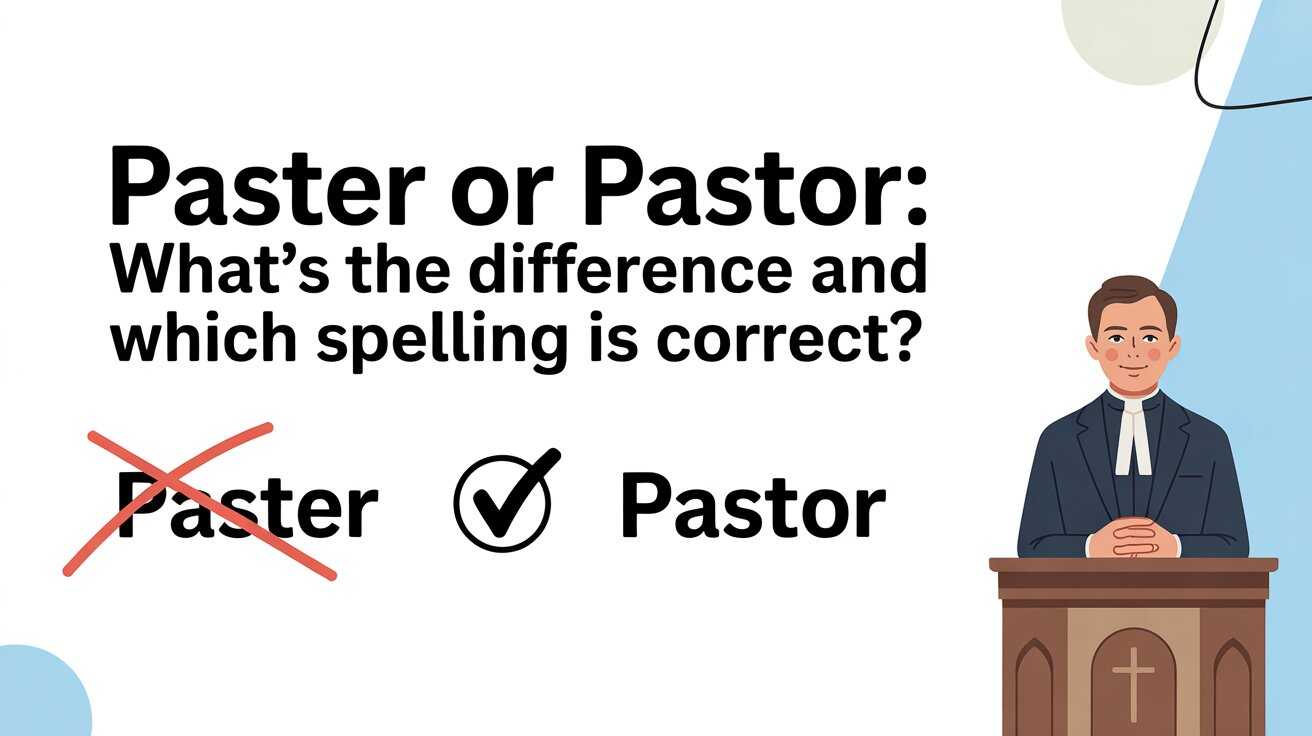
Paster or pastor is a common spelling confusion because the words look and sound similar but have very different meanings. A pastor is a church leader or minister, while a paster refers to someone or something that applies paste or adhesive. In most everyday writing, pastor is the correct word.
⚡ Quick Answer
Pastor is a noun that refers to a religious leader who guides a church congregation. Paster is a much rarer word meaning someone or something that applies paste or adhesive. If you’re writing about a church or ministry, the correct spelling is almost always pastor.
🔍 Key Difference Between Paster and Pastor
At first glance, these words differ by just one letter. But in meaning? They live in completely different worlds.
- Pastor → religion and church leadership
- Paster → glue, paste, or sticking things
Here’s a clear side-by-side comparison.
📊 Side-by-Side Comparison
| Feature | Pastor | Paster |
|---|---|---|
| Meaning | Church leader or minister | One who applies paste or adhesive |
| Part of speech | Noun (sometimes verb) | Noun |
| Common usage | Very common | Rare |
| Field/context | Religion, Christianity | Crafts, printing, adhesives |
| Example sentence | The pastor delivered a sermon. | He used a paster to attach labels. |
Key insight: If your sentence involves a church, the correct word is almost certainly pastor.
📘 What Does “Pastor” Mean?
Simple Definition of Pastor
A pastor is a religious leader responsible for guiding and caring for a church congregation. The word comes from Latin, meaning “shepherd.”
Think of a pastor as someone who:
- leads worship
- teaches scripture
- provides spiritual support
- oversees church members
Role of a Pastor in the Church
In real life, a pastor’s responsibilities go beyond preaching on Sundays. Most pastors:
- counsel families
- organize community programs
- perform weddings and funerals
- mentor church members
Micro-example: If someone says, “Our pastor visited us in the hospital,” they clearly mean a spiritual leader — not someone with glue.
Pastor Used in Sentences
Here are practical examples:
- The pastor welcomed new members to the church.
- She spoke with her pastor about career decisions.
- The church pastor delivered a powerful message.
Pro tip: In 99% of everyday writing, people intend to write pastor, not paster.
READ MORE >>> Companies or Company’s – Correct Usage, Examples, and Grammar Rules
📎 What Does “Paster” Mean?
Simple Definition of Paster
A paster is a person or tool that applies paste, glue, or adhesive to attach something.
Yes — it’s a real word. Just rarely used.
When “Paster” Is Actually Correct
You should use paster only in very specific contexts, such as:
- labeling and packaging
- bookbinding
- crafts and printing
- industrial adhesive work
Micro-example: In a printing factory, a machine that sticks labels might be called a paster.
Paster Example Sentences
- The worker operated the label paster.
- She used a wallpaper paster tool.
- The automatic paster sped up packaging.
Important: In modern everyday English, many people simply say:
- label machine
- glue applicator
- adhesive tool
This is why paster feels unfamiliar to most readers.
🧠 How to Remember Pastor vs Paster (Memory Tricks)
If you’ve ever paused mid-sentence wondering which spelling to use, you’re not alone. Here are simple memory hacks that actually work.
Easy Mnemonic Method
Pastor has an “O” → O for “Organization (church).”
- PastOr → church leader
- PastEr → paste/glue
Quick and sticky (pun intended).
Visual Memory Hack
Picture this:
- Pastor → person at a pulpit
- Paster → person holding glue
Your brain remembers images faster than definitions.
Common Student Mistakes
Students often write:
❌ “The church paster gave a sermon.” ✅ “The church pastor gave a sermon.”
Why the mistake happens: autocorrect and fast typing.
🔊 Pastor vs Paster Pronunciation Guide
Here’s where confusion gets worse: they sound very similar.
Phonetic Breakdown
- Pastor → /PAS-ter/
- Paster → /PAY-ster/ or /PAS-ter/ (varies)
In many accents, they are nearly identical.
Are They Pronounced the Same?
Sometimes — yes.
This is exactly why spelling errors happen so often, especially for:
- ESL learners
- voice typing users
- fast typists
Tips for ESL Learners
If you’re learning English:
- Focus on meaning, not just sound
- Double-check religious context
- Use spell-check carefully
Rule of thumb: Church context → pastor.
⚠️ Common Mistakes People Make
Mixing Pastor and Paster in Writing
This happens most in:
- school essays
- church newsletters
- blog posts
- subtitles and captions
Autocorrect and Spell-Check Errors
Here’s the tricky part: both words are technically correct spellings. So basic spell-check often won’t catch the mistake.
That’s why human proofreading still matters.
📉 Mini Case Study: The Church Bulletin Error
A small community church once printed 500 bulletins that read:
“Welcome our new paster.”
Members noticed immediately. The mistake:
- hurt credibility
- required costly reprints
- caused embarrassment
Lesson: One letter can change the meaning completely.
🧾 Is “Paster” a Real Word? (Myth vs Fact)
Let’s clear up a widespread misconception.
Myth: “Paster is always wrong.” Fact: It is a legitimate but rare English word.
Dictionary Reality
“Paster” exists and historically refers to:
- one who pastes
- a pasting tool
- sometimes a sticker or label
Why Many People Think It’s Wrong
Because in modern usage:
- it appears infrequently
- other terms replaced it
- most people only encounter “pastor”
When You Should Avoid Using It
Even when technically correct, consider clarity.
If your audience might be confused, clearer alternatives include:
- glue applicator
- label machine
- adhesive tool
Clarity beats cleverness. Always.
🏛️ Word Origin and Etymology
Understanding word roots makes the difference stick permanently.
Origin of Pastor
- From Latin pastor
- Meaning: shepherd
- Later used for spiritual shepherds (church leaders)
This metaphor is still used today.
Origin of Paster
- From paste + -er
- Literally means “one who pastes”
Simple and mechanical.
How Their Meanings Diverged
Although spelled similarly, the words evolved in totally different domains:
- Pastor → spiritual care
- Paster → physical sticking
That’s why confusing them changes the meaning dramatically.
✍️ When to Use Pastor vs Paster (Decision Guide)
Still unsure in the moment? Use this quick decision rule.
Use “Pastor” When…
✅ Talking about church ✅ Referring to a minister ✅ Mentioning sermons or congregations ✅ Writing about Christianity
Use “Paster” When…
✅ Discussing glue or paste ✅ Referring to labeling machines ✅ Talking about adhesive work
🧭 Quick Decision Flow
Ask yourself one question:
Is this about church or religion?
- Yes → pastor
- No → possibly paster
This simple check prevents most mistakes.
💡 Expert Writing Tips to Avoid Confusion
✅ Expert Tip: Proofreading Checklist
Before publishing, scan for:
- church references
- religious titles
- ministry mentions
If present, double-check you used pastor.
Academic Writing Advice
In formal writing:
- spell out titles clearly
- avoid rare technical words unless necessary
- prioritize reader clarity
Professional Communication Tips
If you work with church content:
- add “pastor vs paster” to your proofreading checklist
- train team members
- watch voice-to-text errors
One small habit prevents repeated mistakes.
❓ Frequently Asked Questions (PAA Target)
1. Is it pastor or paster?
If you’re referring to a church leader or minister, the correct spelling is pastor. The word paster is rare and usually refers to someone or something that applies paste or adhesive.
2. What does pastor mean?
A pastor is a spiritual leader who guides and cares for a church congregation. Pastors typically preach sermons, provide counseling, and oversee religious activities within a Christian community.
3. What is a paster?
A paster is a person or device that applies paste, glue, or adhesive. The term is uncommon in modern everyday English but still considered technically correct in certain industrial or craft contexts.
4. Is paster a real word?
Yes, paster is a legitimate English word. However, it is rarely used today, which is why many people mistakenly think it is incorrect.
5. Can pastor be used as a verb?
Yes. In some contexts, pastor can function as a verb meaning to serve as a pastor or provide spiritual leadership to a congregation, though this usage is less common than the noun form.
🏁 Final Verdict: Pastor vs Paster
Here’s the bottom line.
- Pastor is the correct word for a church leader — and the one most people mean.
- Paster is real but rare, used mainly in adhesive or labeling contexts.
If your sentence involves ministry, sermons, or church life, choose pastor with confidence.