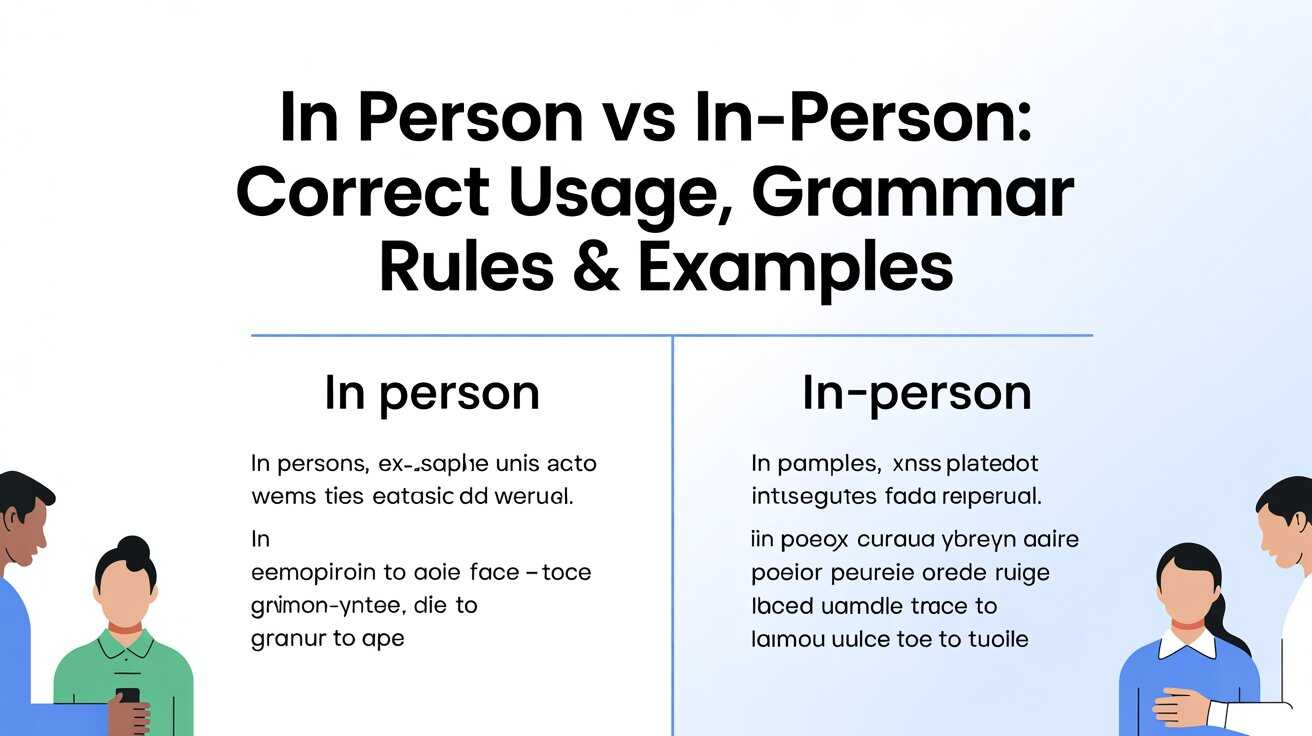
In‑person (with hyphen) is used as a compound adjective before a noun, e.g., an in‑person meeting. In person (no hyphen) functions as an adverbial phrase, e.g., We met in person. Hyphenation clarifies grammatical function, not meaning, helping avoid common mistakes in professional or casual writing.
AI Overview Summary
The difference between in person vs in‑person comes down to grammar and context. Use in‑person with a hyphen when it modifies a noun (in‑person meeting), making it a compound adjective. Use in person without a hyphen as an adverb (We spoke in person). British and American English mostly agree on this rule, though professional writing often favors hyphenation for clarity. Understanding these nuances ensures your emails, reports, and documents are error-free.
Understanding In Person vs In‑Person
Definition & Meaning
The terms may look similar, but the grammar behind them differs:
- In person – an adverbial phrase describing how an action is performed. Example: “I attended the conference in person.”
- In‑person – a hyphenated compound adjective that modifies a noun. Example: “We scheduled an in‑person meeting for next week.”
Micro-Example:
- Correct: “The company offers in‑person workshops.”
- Incorrect: “The company offers in person workshops.” (ambiguous)
Common Mistakes
Many writers confuse the two, especially when writing emails, reports, or meeting invites. Using in person where in‑person is correct can make writing look sloppy.
| Correct Usage | Incorrect Usage | Explanation |
|---|---|---|
| in‑person meeting | in person meeting | Compound adjective before noun requires hyphen |
| met in person | met in‑person | Adverbial use doesn’t take hyphen |
| in‑person interview | in person interview | Hyphen needed before noun |
| attended in person | attended in‑person | Verb modification doesn’t take hyphen |
British vs American English Usage
Both versions are acceptable, but American English favors hyphenation for compound adjectives more strictly. In professional UK writing, both are generally tolerated, but clarity in business and academic writing still favors in‑person before nouns.
Grammar Rules for Hyphenation
Compound Adjective vs Adverbial Phrase
Rule of thumb:
- Before a noun → hyphen (in‑person)
- After a verb → no hyphen (in person)
| Form | Part of Speech | Example |
|---|---|---|
| in‑person | compound adjective | We have an in‑person training session. |
| in person | adverbial phrase | She will join us in person. |
Expert Tip: If it describes “how” the action occurs → no hyphen; if it describes “what type” of thing → hyphen.
When to Drop the Hyphen
Sometimes you might see in-person without hyphen in informal contexts. This is acceptable in casual writing, but formal writing, professional emails, and academic work should follow the hyphen rule.
Position in Sentence
- Before noun: in‑person interview, in‑person meeting, in‑person workshop
- After verb: meet in person, attend in person, speak in person
READ MORE >>> Shiney or Shiny: Which Spelling Is Correct? (Full Grammar Guide)
Usage in Real Contexts
Professional Settings
Hyphenation is especially important in business communication:
Example:
- “Please confirm your in‑person attendance at the annual conference.” Incorrect:
- “Please confirm your in person attendance…” → sounds unpolished.
Mini Case Study: Scenario: A company’s HR team sent an email:
- Original: “The team will attend in person interviews tomorrow.”
- Issue: Ambiguous → could be read as a description of the interviews rather than the mode.
- Corrected: “The team will attend in‑person interviews tomorrow.” Result: Clear, professional, aligned with style guides → improved readability and credibility.
Academic & Formal Writing
- “The study required participants to attend in‑person sessions over two weeks.”
- “Participants provided feedback in person after the workshop.”
Note: Students often forget hyphens in academic papers; following the rule avoids style penalties.
Everyday Conversations
- “I want to meet you in person soon.”
- “We scheduled an in‑person coffee catch-up this afternoon.”
Tip: Even casual writing benefits from proper hyphenation before nouns.
Common Mistakes with In Person vs In‑Person and How to Fix Them
Info: This section highlights the most frequent errors writers make when using “in person” and “in‑person.” Examples include:
- Using in person as an adjective before a noun (“in person meeting”) → should be in‑person meeting.
- Using in‑person after a verb (“We met in‑person”) → correct form: in person.
Content Ideas:
- Add a mini table showing correct vs incorrect usage.
- Include micro-examples from emails or academic papers.
- Provide tips to quickly spot errors in your writing.
In-Person vs In Person in Professional Writing: Quick Tips
Info: This section focuses on how the hyphenation affects professional communication, especially in emails, meetings, and reports.
- Explain that in‑person before a noun signals a compound adjective, making sentences clearer.
- Explain that in person after a verb describes how the action is done.
- Include examples from HR emails, corporate meetings, and remote/hybrid work contexts.
Content Ideas:
- Use a decision flowchart: “If it modifies a noun → in‑person; if it describes an action → in person.”
- Include an expert tip box: “Always hyphenate before nouns in professional writing to avoid ambiguity.”
Hyphenation Rules Explained: When to Use In‑Person vs In Person
Info: This section gives a grammar-focused explanation of hyphen rules. It explains why hyphens exist and when they are mandatory:
- In‑person = compound adjective → hyphen required before a noun.
- In person = adverbial phrase → no hyphen after a verb.
- Include British vs American English notes for regional nuance.
Content Ideas:
- Include a comparison table: Form | Part of Speech | Example.
- Add a mini case study: HR emails, academic essays, or LinkedIn posts that use it correctly and incorrectly.
- Optional: Visual hyphenation decision diagram to reinforce memory.
Decision Tools & Memory Hacks
Decision Flowchart / Quick Test
- Are you describing a noun? → Use in‑person
- Are you describing how someone does something? → Use in person
- Unsure? Substitute with “face-to-face” → check if it modifies a noun.
Table Example:
| Context | Correct Form | Example |
|---|---|---|
| Modifying a noun | in‑person | We held an in‑person meeting. |
| Describing an action | in person | She attended the meeting in person. |
| Unknown | check noun/adverb | Substitute with face-to-face for clarity |
Easy Memory Tricks
- Hyphen = adjective before noun
- No hyphen = how the action is done
- Think “compound adjective + noun” = hyphen
- Think “action description” = no hyphen
Expert Tip: When writing emails, resumes, or reports, quickly check if it describes what type of thing → hyphen, otherwise → no hyphen.
Common Questions (FAQ / PAA Section)
- What is the difference between in person and in‑person?
- In‑person is a compound adjective before a noun. In person is an adverbial phrase after a verb.
- When do you hyphenate in‑person?
- Always before a noun. Example: in‑person meeting, in‑person workshop.
- Can in person function as an adjective?
- Rarely. Standard usage prefers in‑person as the adjective form.
- How do major style guides treat in‑person?
- AP, Chicago, and Merriam-Webster all recommend hyphenation for compound adjective use.
- Is in person more formal than in‑person?
- Not inherently, but professional writing favors hyphen for clarity in documents and emails.
Real-World Mistakes & Mini Case Studies
- Case Study 1: HR emails misusing in-person → corrected for clarity
- Case Study 2: Academic papers with in person as adjective → corrected to in‑person
- Table:
| Original Sentence | Issue | Corrected |
|---|---|---|
| “Attend in person interviews tomorrow.” | Ambiguous, adjective used incorrectly | “Attend in‑person interviews tomorrow.” |
| “Students must attend in-person sessions.” | Incorrect hyphenation placement | “Students must attend in‑person sessions.” |
| “We met in-person to discuss results.” | Misplaced hyphen after verb | “We met in person to discuss results.” |
Conclusion & Key Takeaways
- Always use hyphen for compound adjectives before nouns: in‑person meeting, in‑person session.
- Use no hyphen for adverbs describing how an action is performed: We met in person, attended in person.
- Check context, not intuition: Decision tables and memory hacks prevent mistakes.
- Professional & academic writing favors hyphenation: Enhances clarity and credibility.
- Stay updated: Remote work trends, style guides, and voice search patterns influence usage.
Pro Tip: When in doubt, think: “Am I describing a noun (hyphen) or action (no hyphen)?” A quick check prevents embarrassment in emails, job applications, and formal documents. in person vs in-person