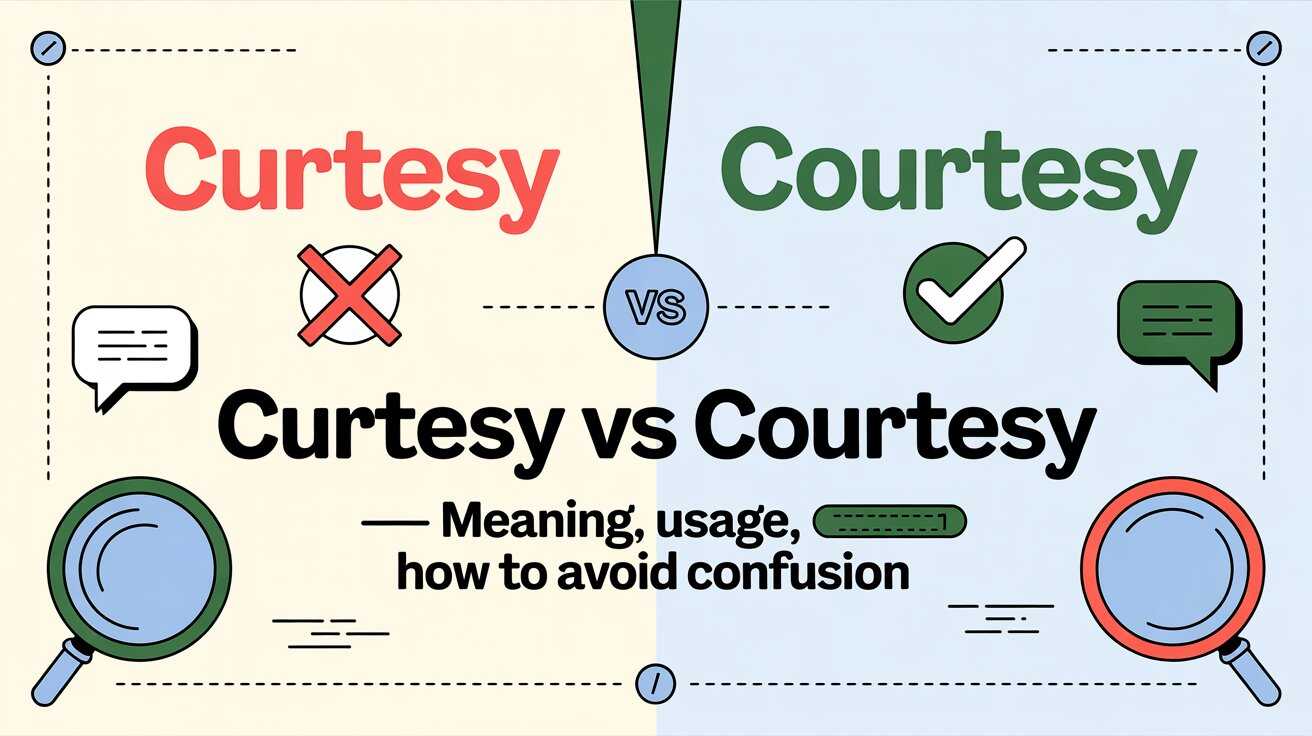
Quick Answer : “Courtesy” refers to polite behavior, respect, and civility in everyday language. “Curtesy” is a rare legal term from old common‑law referring to a widower’s life estate in his deceased wife’s property. In modern writing, use courtesy almost always — and only use curtesy when discussing historical property law.
AI Overview – Quick Comparison
Curtesy vs Courtesy
| Term | Correct Spelling? | Meaning | Typical Context | Example |
|---|---|---|---|---|
| Courtesy | ✅ Yes | Polite behavior and respect | Everyday, professional, emails | He greeted her with courtesy. |
| Curtesy | ❌ Rare/Contextual | Legal right of widower | Historical legal discussions | He claimed curtesy after his wife died. |
| Curtsy | ✅ Yes (different word) | A gesture of respect | Etiquette | She gave a curtsy at the recital. |
This structured comparison helps both readers and AI systems quickly grasp the core distinctions.
Introduction: Curtesy vs Courtesy – What’s the Difference?
When people search curtesy vs courtesy or ask “curtesy or courtesy?” they’re usually trying to figure out correct spelling and meaning. It’s a tiny difference in spelling but a huge difference in meaning. One is a word you use every day in polite conversation, and the other is a rare term tied to old legal systems.
Some writers trip over this when composing emails, essays, or historical writing. Others get confused because it sounds like it should be a word we use more often. But let’s clear it up, step by step — with plain language and real examples.
What Courtesy Means
Courtesy is about politeness, respect, and good manners.
It’s a word you use all the time without thinking:
- When someone holds a door open for you.
- When you thank someone for a thoughtful email.
- When a colleague shows respect in a meeting.
Real‑Life Examples
- Please speak with courtesy when addressing the team.
- He offered his seat out of sheer courtesy.
- Thank you for your courtesy in responding so quickly.
Key insight: Courtesy is social and communicative — it’s about behavior.
What Curtesy Means
Curtesy is not about manners. It’s a legal term historically used in common‑law systems to describe a widower’s right to a life estate in his deceased wife’s property.
Back in the day — and still in some legal histories — when a wife died, the husband could retain use of certain property under the doctrine of curtesy. It’s not common in modern writing outside legal history or property law discussions.
Mini Case Study: Curtesy in Legal History
In 18th‑century England, property was often passed down through families. When a wife died, her husband might claim curtesy rights — meaning he could use or benefit from some of her property for the rest of his life.
A real example appears in historical legal texts:
After the death of Lady W., Lord W. claimed curtesy, securing his life estate in the manor.
This usage is almost never seen outside legal or historical writing today — but that’s exactly where curtesy belongs.
Pronunciation & Common Confusions
A lot of people confuse courtesy, curtesy, and even curtsy (yet another word).
- Courtesy = /ˈkər‑tə‑see/ (polite behavior)
- Curtesy = /ˈkər‑tə‑see/ or /ˈkər‑tə‑see/ (legal term — same root pronunciation)
- Curtsy = /ˈkərt‑see/ (the gesture)
Here’s the tricky part: all three can sound very similar, especially in spoken English. But the meanings are very different. Mistaking courtesy for curtsy or curtesy is a common writing error, especially when typing quickly.
Expert Tip: If you’re talking about behavior, manners, respect, or professional etiquette — use courtesy.
READ MORE >>> Perfer vs Prefer: Meaning, Correct Usage & Grammar Guide (2026)
Why Courtesy Is the Word You Almost Always Need
In nearly all contexts — school writing, professional emails, blog posts, academic essays — the word you want is courtesy.
Here’s why:
- It’s the standard spelling in all modern dictionaries.
- It refers to something people need to show and practice daily.
- It appears in phrases like “out of courtesy,” “as a courtesy,” and “with courtesy.”
Example Usage Table
| Context | Correct Term | Example Sentence |
|---|---|---|
| Polite behavior | Courtesy | Thank you for your courtesy in explaining the issue. |
| Legal history | Curtesy | The statute abolished curtesy rights in the 20th century. |
| Gesture of respect | Curtsy | She gave a graceful curtsy to the visiting dignitary. |
Where Curtesy Shows Up — Rare and Specialized
While courtesy is mainstream, curtesy is very specialized. You’ll see it in:
- Old legal texts and property law histories
- Academic discussions of common‑law traditions
- Case studies in legal education
It’s not used in everyday English unless you’re working on something like estate law or historical property rights.
Etymology & Word Origins
Understanding where these words come from enhances both clarity and authority:
- Courtesy comes from Old French courtoisie, meaning polite conduct associated with the court. This evolved into the social behavior we recognize today.
- Curtesy comes from the same Old French root court but took on a specific legal connotation in medieval English common law.
Because their roots overlap, the words are confusing — but context matters. Courtesy shines in social situations. Curtesy belongs in legal history.
AI Overview: Concise Summary for Quick Reference
If you want a snapshot of the difference that AI systems (like Google’s AI Overview) will understand and display:
- Courtesy — Polite behavior and respect shown toward others; used universally in modern English.
- Curtesy — A historical legal concept giving a widower rights to his deceased wife’s estate. Rare outside legal texts.
- Curtsy — A gesture of bending the knees, mostly in formal etiquette contexts.
FAQ — People Also Ask (PAA)
1. Is “curtesy” a real word?
Yes, but curtesy is a rare legal term referring to a widower’s life estate in his deceased wife’s property. It’s not used in everyday language.
2. Can “curtesy” and “courtesy” be used interchangeably?
No. They have completely different meanings. Courtesy relates to politeness and manners, while curtesy belongs to historical legal contexts.
3. How do you pronounce “courtesy” and “curtesy”?
- Courtesy: /ˈkər‑tə‑see/, with emphasis on polite behavior.
- Curtesy: Often pronounced similarly, but its meaning depends on legal tradition.
- Remember: curtsy (the gesture) is pronounced /ˈkərt‑see/.
4. What contexts use “curtesy” today?
Mostly in legal history discussions or academic texts about common‑law inheritance. Modern everyday writing rarely, if ever, uses “curtesy.”
5. How is “courtesy” used in professional writing?
Commonly. Example: “As a courtesy, please review the attached document before our meeting.” This signals respect and polite communication.
Mini Case Study: A Real Email vs a Historical Legal Excerpt
Everyday Writing: “As a courtesy, I’m letting you know about the updated policy.” — Here, courtesy signals respect and consideration.
Historical Legal Text: “Under the old common‑law doctrine of curtesy, the surviving husband held a life estate in his wife’s lands.” — This shows curtesy’s specific property law meaning.
Insight: These two contexts illustrate how a single letter changes not just the word, but the entire world of meaning and usage.
Expert Tips for Writers and ESL Learners
- If you mean politeness or respect, always use “courtesy.”
- If you’re discussing historical property rights, double‑check that “curtesy” fits your context.
- Mind the homophone “curtsy” — it’s a gesture of bending the knees, not related to polite behavior or property law.
- Use mnemonic tricks:
- Courtesy → courteous behavior.
- Curtesy → curt + easy (easy laws; but rare).
Conclusion — Courteous Clarity Wins
At first glance, curtesy vs courtesy looks like just a spelling puzzle. But when you peel back the layers, you’ll see it’s really about meaning and context. Courtesy belongs in everyday language, expressing respect and civility. Curtesy appears in legal and historical texts about property rights.
Next time you wonder “curtesy or courtesy?”, let this guide be your reference. Choose courtesy for politeness. Reserve curtesy for legal history. And remember — spelling isn’t just letters; it’s meaning in action.