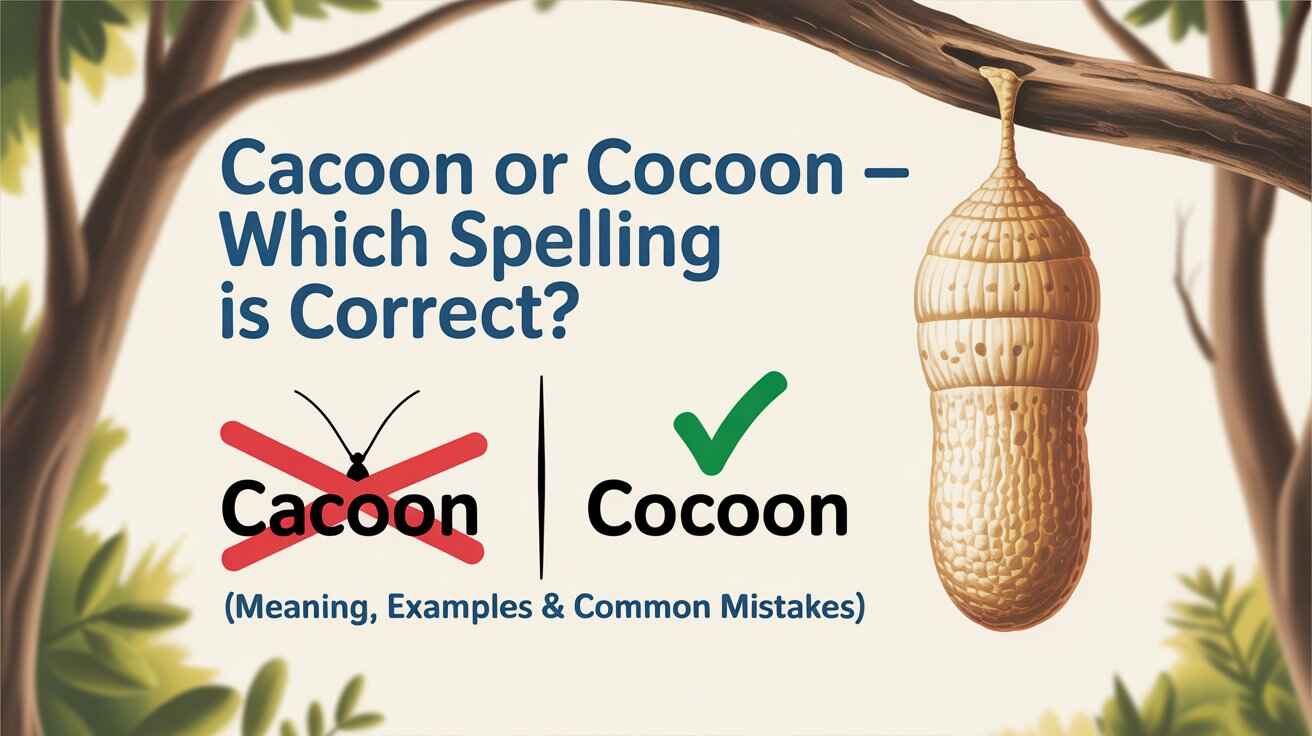
Cacoon or cocoon is a common spelling confusion that many people face while writing English. Both words sound exactly the same when spoken, which makes the mistake even more confusing. Students, bloggers, ESL learners, and even native speakers often wonder which spelling is correct and why.
Understanding the correct usage matters. This article explains the difference clearly, explores the meaning of cocoon, explains why “cacoon” appears so often, and shows you how to remember the correct spelling easily.
Quick Answer — Cacoon or Cocoon?
The correct spelling is cocoon.
Cacoon is a common spelling mistake and should not be used in standard English writing.
The confusion usually happens because the word cocoon is pronounced as “ka-koon,” which makes many people assume the spelling starts with “ca.” However, English spelling does not always follow pronunciation, and this is one of those cases.
Why People Confuse “Cacoon” and “Cocoon”
The main reason people confuse cacoon and cocoon is pronunciation. When spoken, the word sounds the same regardless of spelling. This leads many writers to spell it the way it sounds rather than the way it is written.
Another reason is the presence of double vowels. English words with double “oo” can be tricky, especially for learners. Words like balloon, spoon, and moon follow similar patterns, but many people forget that cocoon belongs to the same group.
Autocorrect does not always help either. In informal writing, messaging apps, or quick typing, “cacoon” may go unnoticed, which allows the mistake to spread.
Meaning of Cocoon (Simple + Detailed Explanation)
The word cocoon has both a literal meaning and a figurative meaning. Understanding both makes it easier to use the word correctly in different contexts.
Cocoon Meaning in Biology
In biology, a cocoon is a protective covering made by certain insects during a stage of their life cycle. Moths and silkworms spin cocoons around themselves as they transform into adults.
This stage is part of metamorphosis, where the insect changes form safely inside the cocoon. The cocoon protects it from predators, weather, and environmental danger.
Many people confuse a cocoon with a chrysalis. While both are related to insect development, they are not the same. Butterflies usually form a chrysalis, while moths create cocoons.
Cocoon Meaning in Everyday Language
Outside biology, cocoon is often used in a metaphorical sense. It describes a state of comfort, safety, or isolation.
People say they are “living in a cocoon” when they avoid the outside world or surround themselves with comfort. This figurative usage is common in literature, psychology, and daily speech.
Is “Cacoon” a Word?
In standard English, cacoon is not a correct spelling of cocoon. It does not appear in major English dictionaries as a valid alternative spelling.
Sometimes, the word “cacoon” may appear as:
- A typing error
- A phonetic spelling
- A brand name or username
Cocoon vs Cacoon — Side-by-Side Comparison Table
| Feature | Cocoon | Cacoon |
|---|---|---|
| Correct spelling | Yes | No |
| Dictionary entry | Yes | No |
| Used in biology | Yes | No |
| Used metaphorically | Yes | No |
| Formal writing | Recommended | Avoid |
How to Remember the Correct Spelling of Cocoon
A simple memory trick can help you avoid this mistake forever.
Think of the double “oo” as a closed, rounded shape just like something being wrapped and protected. A cocoon encloses and protects, so it makes sense that it uses double “o.”
Another tip is to remember similar words:
- Balloon
- Spoon
- Moon
All use double “o,” just like cocoon.
How to Use “Cocoon” in a Sentence
Using cocoon correctly becomes easy once you see it in context.
Sentence Examples (Literal Use)
The silkworm spins a cocoon to protect itself during metamorphosis.
Scientists studied the insect inside its cocoon to observe development.
Sentence Examples (Metaphorical Use)
She stayed in a cocoon of comfort, avoiding change for years.
During winter, he cocooned himself indoors with books and coffee.
Cocoon in Metaphors, Literature, and Daily Speech
Writers often use cocoon as a symbol of transformation and protection. It represents a phase where growth happens quietly before change becomes visible.
In literature, a cocoon can symbolize emotional healing, personal growth, or isolation. In daily speech, people use it casually to describe comfort zones or safe spaces.
This metaphorical use makes cocoon a powerful word beyond its biological meaning.
Cocoon vs Chrysalis — Are They the Same Thing?
Although often confused, a cocoon and a chrysalis are not the same.
A cocoon is usually spun from silk and surrounds the insect completely. A chrysalis is a hard outer shell formed by butterflies and does not involve silk.
Understanding this difference is especially useful in biology writing and educational content.
Common Spelling Mistakes Similar to “Cacoon”
English has many spelling mistakes caused by pronunciation confusion. Some common examples include:
- Balloon vs baloon
- Occasion vs ocassion
- Committee vs commitee
- Accommodation vs acomodation
These mistakes show why learning correct spelling patterns is important.
British vs American English — Does the Spelling Change?
The spelling cocoon remains the same in both American English and British English. There is no regional variation for this word.
This means that regardless of your audience, cocoon is always the correct spelling.
FAQs About Cacoon or Cocoon
Is cacoon ever correct?
No, cacoon is considered a misspelling in standard English.
Why does cocoon have two o’s?
The spelling comes from its linguistic origin and follows common English double-vowel patterns.
Can cocoon be used as a verb?
Yes. You can say someone “cocooned themselves” to describe isolation or comfort.
What is the plural of cocoon?
The plural form is cocoons.
Final Verdict — Which One Should You Use?
The answer is clear and simple. Cocoon is the correct spelling and should always be used in writing. Cacoon is a common mistake caused by pronunciation and should be avoided.
If you remember the double “oo” rule and understand the meaning behind the word, you will never confuse these spellings again. Clear spelling leads to clear communication, and that always improves your writing.