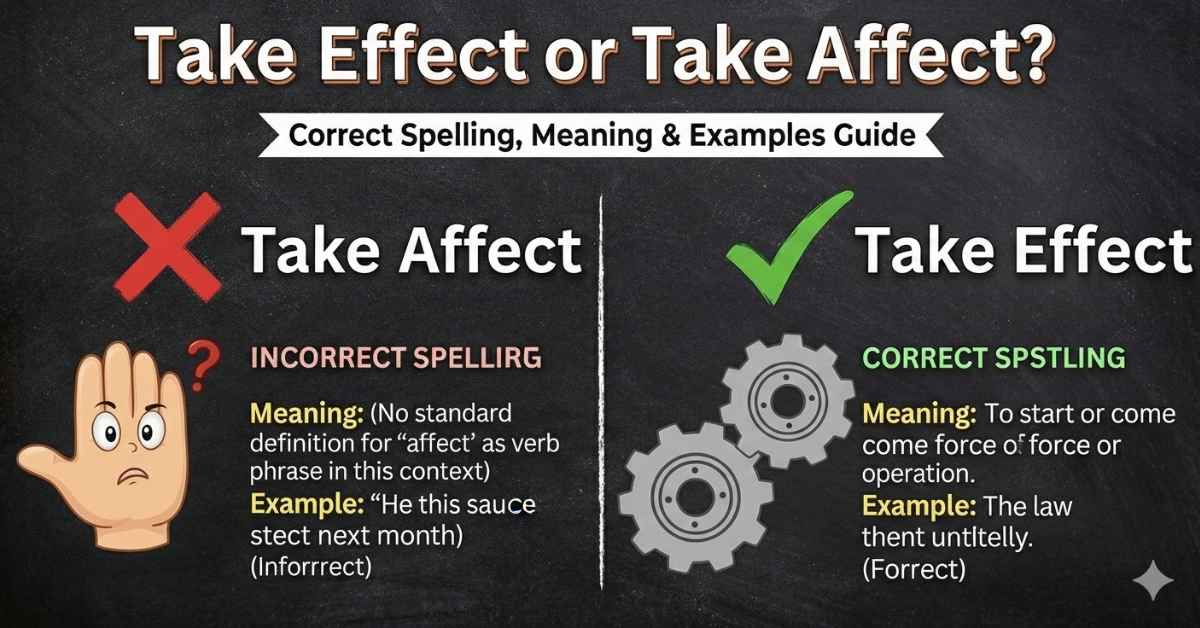
Take effect or take affect — if you’ve ever paused mid-sentence wondering which one is correct, you’re not alone. This is one of the most common English writing confusions because the words affect and effect look similar, sound close, and are frequently mixed up in everyday writing.
The good news? The answer is simple, and once you learn the rule, you’ll never get stuck again.
In this guide, you’ll learn:
- The correct phrase
- The meaning of “take effect”
- Why “take affect” is almost always wrong
- The affect vs effect rule (with an easy memory trick)
- A table comparison, real examples, common mistakes, and FAQs
Is It Take Effect or Take Affect?
Let’s clear it up immediately:
✅ Correct: take effect ❌ Incorrect (almost always): take affect
So if your question is:
Is it take effect or take affect?
The correct phrase is “take effect.”
“Take effect” is a standard English expression meaning something becomes active, begins to apply, or starts producing results—like a new law, a policy, or medicine.
What Does “Take Effect” Mean?
The phrase take effect means:
- to begin to work
- to become active
- to start producing results
- to be enforced
- to come into action
In simple words: when something takes effect, it is no longer just an idea—it becomes real, operational, and applicable.
Common real-life contexts where “take effect” is used
- Law: “The new law will take effect next month.”
- Policies: “The updated policy takes effect on March 1.”
- Medicine: “This medicine takes effect in 30 minutes.”
- Rules: “The rules take effect immediately.”
- Decisions: “The decision will take effect after approval.”
Why “Take Affect” Is Usually Wrong
Most of the time, “take affect” is simply a typo or grammar mistake.
That’s because:
- Affect is usually a verb
- Effect is usually a noun
And the phrase take effect needs a noun after “take,” because “take” is acting like a verb that receives an object.
So:
- “take effect” ✅ (effect = noun)
- “take affect” ❌ (affect is usually a verb, not used like this)
Affect vs Effect: The Real Grammar Rule (Simple & Powerful)
This is the #1 rule you should remember:
✅ Affect = Verb (Action)
Affect means to influence or impact something.
Examples:
- “Stress can affect your health.”
- “The weather may affect the match.”
✅ Effect = Noun (End Result)
Effect means the result, outcome, or consequence.
Examples:
- “The medicine had a strong effect.”
- “The new rule had no effect on sales.”
The Best Memory Trick (Never Forget Again)
Here’s the easiest trick:
- Affect = Action
- Effect = End result
Once you keep this in mind, choosing the right word becomes effortless.
Take Effect or Take Affect? (Comparison Table)
Here’s a quick table to make it crystal clear:
| Phrase | Correct? | Part of Speech | Meaning | Example |
|---|---|---|---|---|
| take effect | ✅ Yes | Effect = noun | become active / start working | “The policy will take effect next week.” |
| take affect | ❌ No (almost always) | Affect = usually verb | incorrect phrase | “The policy will take affect next week.” ❌ |
Can “Affect” Ever Be Correct? (Rare Exception Explained)
Yes—but not in the phrase “take affect.”
Affect as a noun (rare usage)
In psychology, affect can be used as a noun meaning emotion or visible emotional expression.
You might see:
- “flat affect”
- “blunted affect”
- “emotional affect”
However, even in this meaning, we still don’t say “take affect.” So for everyday writing, school, blogging, emails, and professional writing, you can safely treat take affect as incorrect.
Can “Effect” Be a Verb? (Advanced but Important)
Yes! This is where English gets interesting.
Effect can also be used as a verb meaning:
- to bring about
- to cause
- to make something happen
Example:
- “The manager worked to effect change in the company.”
- “The policy was designed to effect improvement in safety.”
But does that change “take effect”?
No.
Even though “effect” can be a verb in special cases, the expression take effect remains the correct and widely accepted phrase.
Examples of “Take Effect” in Sentences (Correct Usage)
If you want to use this phrase confidently, these examples will help.
Legal and policy examples
- “The new law will take effect on January 1.”
- “The updated rules take effect immediately.”
- “The contract becomes enforceable when the clauses take effect.”
- “The policy will take effect after the final approval.”
Medicine and health examples
- “This medicine usually takes effect within 30 minutes.”
- “Pain relief may take effect slowly depending on the dose.”
- “The vaccine starts to take effect after a few weeks.”
Everyday life examples
- “The changes will take effect tomorrow.”
- “Once the update takes effect, the app will run faster.”
- “The new schedule will take effect next Monday.”
- “The new rules take effect at midnight.”
- “His words started to take effect, and people listened.”
Notice how “take effect” always fits naturally with:
- rules
- laws
- medicine
- updates
- decisions
- changes
That’s because all these things become active or start working at a certain point.
Wrong Examples (Take Affect) + Corrections
Let’s fix common mistakes the easy way.
Incorrect
- “The new law will take affect tomorrow.”
✅ Correct
- “The new law will take effect tomorrow.”
Incorrect
- “The medicine didn’t take affect.”
✅ Correct
- “The medicine didn’t take effect.”
Incorrect
- “The changes will take affect next week.”
✅ Correct
- “The changes will take effect next week.”
Synonyms of “Take Effect” (NLP & Semantic Boost)
To write naturally and improve SEO coverage, you can also use synonyms.
Formal synonyms (legal/government/professional writing)
- go into effect
- come into effect
- enter into force
- become effective
- be enforceable
- be implemented
- be activated
Example:
- “The regulation will go into effect next month.”
- “The law will enter into force on March 1.”
Informal synonyms (casual writing)
- kick in
- start working
- begin working
- start showing results
Example:
- “The medicine will kick in soon.”
Quote: “If you want your writing to sound professional, use take effect in formal contexts and kick in only in casual conversation.”
Common Related Confusions (That Many Writers Get Wrong)
This topic connects to other confusing grammar patterns.
1) “In effect” vs “take effect”
- in effect = currently active
- take effect = becomes active
Examples:
- “The rule is in effect.” (already active)
- “The rule will take effect tomorrow.” (not active yet)
2) Affect change vs effect change
This is tricky and advanced.
- affect change (affect = influence) “This decision may affect change in the workplace.” (less common)
- effect change (effect = bring about) ✅ “This policy will effect change in the workplace.”
3) Effective date (legal concept)
In contracts and law, you’ll often see:
- effective date = date when something takes effect
Example:
- “The effective date is February 15.”
This is exactly connected to your keyword topic and adds strong SEO relevance.
Pronunciation + Spelling Tips (Simple but Useful)
Pronunciation
- affect → uh-FEKT
- effect → ih-FEKT
They sound close, which is why people confuse them.
Spelling tip
If you’re unsure, remember:
✅ “take effect” uses E, like Event starts / Enabled / Enforced It’s a “beginning” word, not an “influence” word.
Common Writing Scenarios (Where This Mistake Happens)
This phrase often shows up in writing that involves rules or timing.
In formal writing / academic writing
Use:
- take effect
- go into effect
- become effective
Avoid:
- take affect (incorrect)
In business emails
Correct:
- “The updated policy will take effect on Monday.”
This sounds professional, clear, and correct.
In contracts & official documents
Use legal phrases:
- “This agreement shall take effect as of the effective date.”
This aligns with formal writing tone and grammar accuracy.
READ MORE >>> Is Good Morning One Word? Correct Spelling & Email Usage Guide
Mini Case Studies (Real-Life Examples)
Case Study 1: A law change
A city announces:
“The new speed limit law will take effect on March 1.”
Meaning: enforcement begins March 1, not today.
Case Study 2: Medicine timing
A patient asks:
“How long until the medicine takes effect?”
This is extremely common in health conversations. It means:
- when will the medicine start producing results?
Case Study 3: A company policy update
HR email says:
“The work-from-home policy will take effect next week.”
This tells employees exactly when the policy becomes operational.
Take Effect or Take Affect? FAQs
Take effect or take affect?
✅ Correct: take effect ❌ Incorrect: take affect (almost always)
Is it take effect or take affect?
It is take effect. This is the standard grammar-correct phrase in modern English.
What does “take effect” mean?
It means something begins to apply, becomes active, or starts working.
Is “take affect” ever correct?
In everyday English and writing, no. It’s typically a spelling mistake.
When do rules/laws take effect?
Usually when they become enforceable, which is often stated as:
- “effective date”
- “start date”
- “implementation date”
How long does it take for medicine to take effect?
It depends on the medicine type, dosage, and body response—but the phrase means:
- “how long until it starts working?”
What’s the easiest way to remember affect vs effect?
Use the best rule:
- Affect = Action
- Effect = End result
Is “take effect” formal or informal?
It is neutral and professional, appropriate for:
- emails
- academic writing
- legal writing
- business communication
Final Summary
Let’s lock it in:
- ✅ The correct phrase is take effect
- ❌ “take affect” is almost always incorrect
- take effect means “to become active” or “start working”
- Remember:
- Affect = influence (verb)
- Effect = result (noun)
If you use take effect in your writing, your sentence will sound clear, professional, and grammatically correct every time.