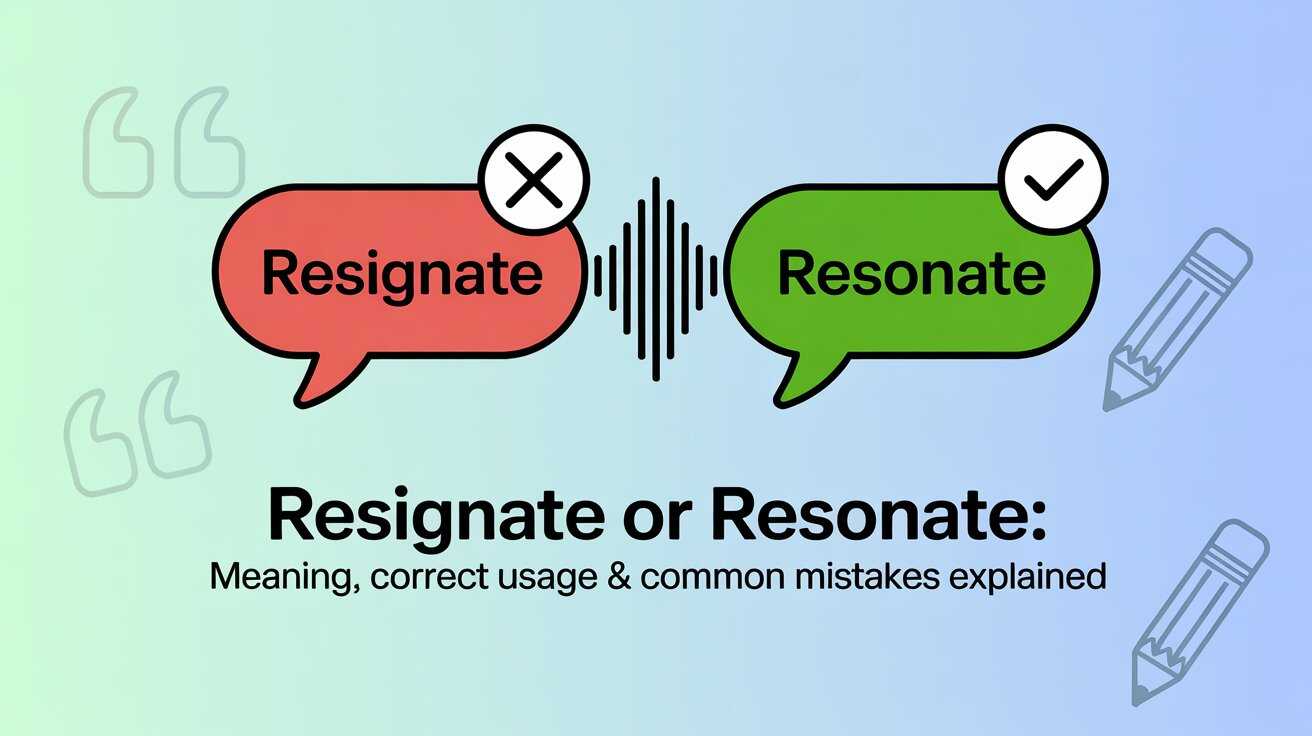
Resignate or Resonate is a question that often confuses English learners and even native speakers. Many people are unsure which word is correct, why “resignate” appears in informal writing, and how to use “resonate” properly. In this article, we’ll explore the meanings, differences, examples, and tips to ensure you use the right word in your writing and speech. We’ll also compare Resignate vs Resonate so you can confidently avoid common mistakes.
What Does “Resonate” Mean?
The word resonate has both literal and figurative meanings, which is why it is widely used in English.
- Literal meaning: Resonate refers to producing or being filled with sound. For example:
- “The church bell resonated across the valley.”
- “This note resonates clearly on the piano.”
- Figurative meaning: Resonate also describes an emotional or intellectual connection. It is used when something deeply affects or connects with someone:
- “Her speech resonated with the audience, leaving everyone inspired.”
- “The poem resonated with me because it reflected my personal experiences.”
Understanding these meanings helps prevent misuse and ensures your writing communicates clearly.
Why “Resignate” Is Incorrect
Despite its frequent appearance, resignate is not a recognized English word. People often mistakenly use it due to:
- Phonetic similarity: “Resignate” sounds similar to “resonate.”
- Root confusion: Some may mistakenly blend resign (to quit) with resonate.
- Autocorrect or typos: Digital writing tools sometimes autocorrect to “resignate,” reinforcing the error.
Incorrect examples:
- “He tried to resignate the idea in the meeting.”
- “This concept really resignates with the team.”
Always use resonate instead, as it is recognized in dictionaries and standard English usage.
Resignate vs Resonate – Key Differences
To make things clearer, here’s a simple comparison of Resignate vs Resonate:
| Word | Correctness | Usage Context | Example |
|---|---|---|---|
| Resonate | ✅ Standard | Literal & figurative | “The music resonated in the concert hall.” |
| Resignate | ❌ Incorrect | Typo / misspelling | “The speech resignated with the students.” |
By understanding this difference, you can confidently choose the correct word in any context.
Literal vs Figurative Uses of Resonate
Literal Uses
Resonate is often used to describe physical vibrations or sound:
- “The guitar strings resonated beautifully after tuning.”
- “The cathedral’s acoustics make every note resonate.”
Figurative Uses
Figuratively, resonate refers to ideas, speeches, or messages that emotionally or intellectually connect with someone:
- “Her story resonated with everyone in the room.”
- “The marketing campaign resonated with young audiences due to its humor and creativity.”
By distinguishing between literal and figurative usage, you ensure your writing is accurate and professional.
Examples of Resonate in Sentences
Here are practical examples to help you use resonate correctly in different contexts:
Formal Writing:
- “The professor’s lecture on climate change resonated with students across all disciplines.”
Casual Conversation:
- “That movie really resonated with me; I could relate to the main character.”
Professional/Workplace Writing:
- “The CEO’s message resonated strongly with the team, boosting morale.”
Creative Writing:
- “The poem resonated deeply with those who had experienced loss.”
Professional & Workplace Usage
Using resonate correctly in professional writing enhances clarity and credibility:
Do’s:
- Use in presentations or speeches: “This strategy resonates with our target audience.”
- Incorporate in emails or reports to convey emotional or intellectual impact.
Don’ts:
- Avoid using “resignate” in any professional or academic context.
- Do not overuse resonate in the same paragraph; it may feel repetitive.
How to Pronounce Resonate Correctly
Many people confuse the pronunciation of “resonate,” which can lead to miscommunication or spelling errors. Here’s how to say it properly:
- Phonetic pronunciation: /ˈrezəˌnāt/
- Break it down: “REZ-uh-nate” — emphasis on the first syllable.
- Tips:
- Avoid pronouncing it as “re-sign-ate” — that is incorrect and sounds like the non-word resignate.
- Practice with common sentences:
- “The music resonates through the auditorium.”
- “Her words resonated with everyone listening.”
Pronouncing it correctly not only helps in speech but also reinforces the proper spelling when writing.
Synonyms for Resonate and How to Use Them
Using synonyms can make your writing more engaging, but it’s important to choose the right word based on context:
- Echo: Often used literally or metaphorically for repeating or reflecting ideas.
- Example: “His ideas echoed throughout the meeting.”
- Reverberate: Usually describes sound, but can also describe emotional impact.
- Example: “The teacher’s advice reverberated in the students’ minds.”
- Strike a chord: Figurative expression for something that emotionally connects.
- Example: “The charity campaign struck a chord with the public.”
- Connect / Impact: General alternatives for emotional or intellectual resonance.
Choosing the right synonym depends on whether you want literal sound meaning or emotional/figurative meaning.
Resonate in Literature, Media, and Everyday Speech
“Resonate” is widely used in books, movies, speeches, and marketing because it conveys both literal and emotional impact:
- Literature: Writers often use “resonate” to describe themes or messages that echo in a character’s mind.
- Example: “The moral of the story resonated long after the final chapter.”
- Media & Marketing: Advertisements or campaigns use “resonate” to indicate connection with the audience.
- Example: “The new slogan resonates with young consumers because it reflects their lifestyle.”
- Everyday Speech: People use it in casual conversation to describe feelings, ideas, or experiences that feel meaningful.
- Example: “Her advice really resonated with me; I’ll remember it forever.”
This section shows that “resonate” is versatile and widely accepted in both professional and casual contexts, unlike “resignate.”
Tips to Remember the Correct Spelling
Here are some strategies to avoid confusing resonate and resignate:
- Mnemonic Tip: Think of “resonate” as “re-sound” — it comes from the Latin resonare, meaning “to sound again.”
- Proofreading: Always check for the “i” in resignate; if it’s present, it’s likely incorrect.
- Practice with examples: Use “resonate” in sentences daily to reinforce correct spelling.
Common Misconceptions About Resignate and Resonate
Many people have false assumptions about these words. Let’s clarify:
- Myth 1: Resignate is acceptable in English. ❌
- Myth 2: Resonate only relates to sound. ❌ It also describes emotional or intellectual impact.
- Myth 3: Resonate and resignate can be used interchangeably. ❌
Understanding these misconceptions prevents errors in writing and speech.
Origin and Etymology of Resonate
The word resonate comes from the Latin word resonare, meaning “to sound again.” Over time, its usage expanded from describing sound vibrations to figurative meaning, such as ideas and emotions that “echo” in someone’s mind.
Historically, “resonate” appeared in English literature in the 17th century and has since evolved into both literary and professional usage, making it a versatile and important word to know.
FAQ Section
Q1: Is resignate a real word? No. Resignate is not recognized in English dictionaries and should never be used in formal writing.
Q2: What is the difference between resignate and resonate? Resonate is the correct word for both literal sound and figurative emotional connection. Resignate is a common misspelling.
Q3: How do I use resonate correctly in a sentence? Examples:
- “Her words resonated with the audience.”
- “The song resonates with people of all ages.”
Q4: Can resonate be used figuratively? Yes, it is often used to describe ideas, feelings, or messages that have a lasting impact.
Q5: Why do people confuse resignate with resonate? The confusion comes from phonetic similarity, autocorrect errors, and misunderstanding of word roots.
Conclusion
In summary, resonate is the correct English word, while resignate is a common mistake. By understanding its literal and figurative uses, professional applications, and historical origins, you can use resonate confidently in writing, conversation, and presentations. Avoiding common misconceptions and practicing correct spelling ensures clarity, professionalism, and effective communication.