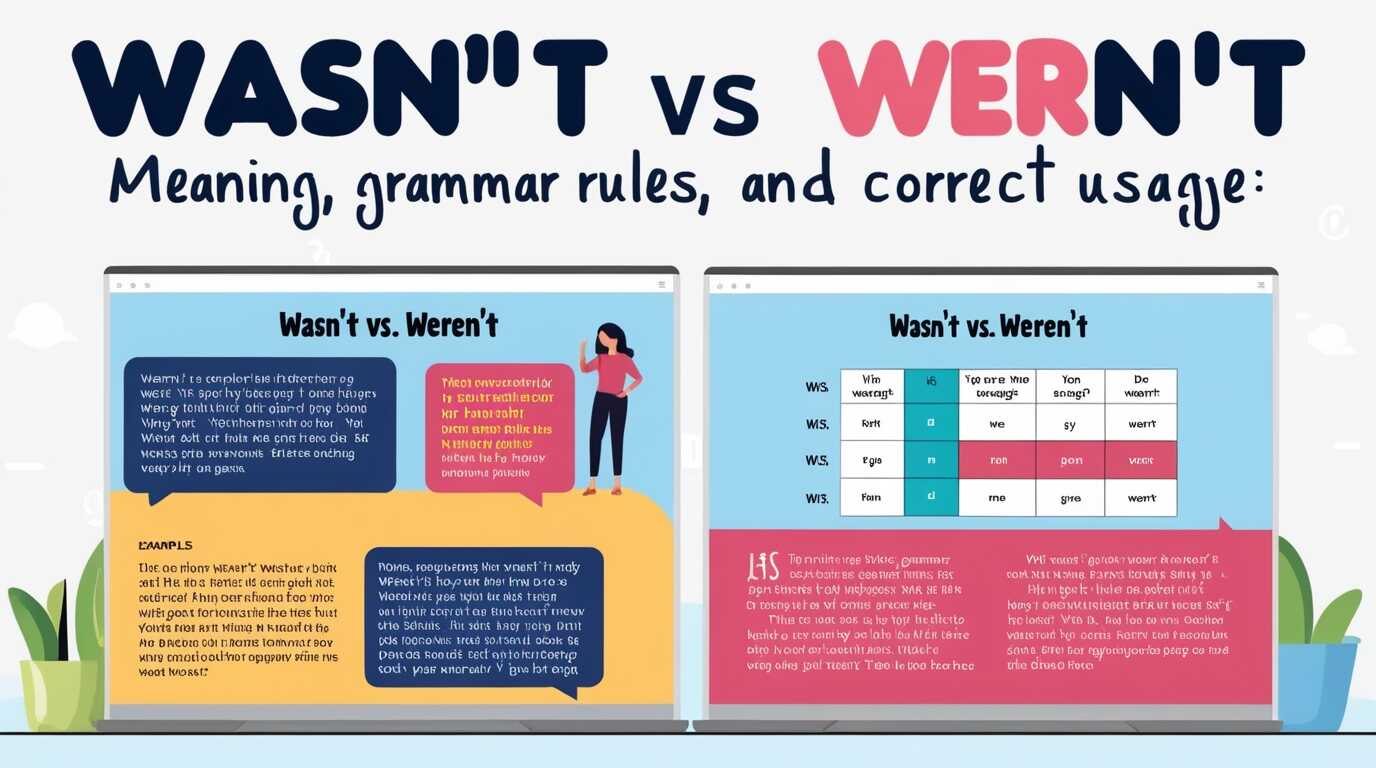
Wasnt vs Werent is a common source of confusion for English learners and even native speakers. Both are contractions of “was not” and “were not,” but they are used differently depending on the subject and context. Understanding the correct usage is essential for grammar accuracy, especially in writing, speaking, and formal English. In this guide, we will explain the rules, provide examples, highlight common mistakes, and give practical tips to help you master wasn’t and weren’t confidently.
What Does Wasn’t Mean?
The word wasn’t is a contraction of “was not”. It is used with singular subjects such as I, he, she, or it. Wasn’t expresses a negative statement about something in the past.
Rules for Using Wasn’t
- Always pair wasn’t with singular nouns or pronouns.
- Use it to indicate something did not happen or was not true in the past.
Examples
- “He wasn’t at the party last night.”
- “I wasn’t aware of the change in schedule.”
- “It wasn’t easy to finish the project on time.”
What Does Weren’t Mean?
The word weren’t is a contraction of “were not”. It is used with plural subjects like we, they, or you. Additionally, weren’t is used with singular subjects in the subjunctive mood, which expresses hypothetical or unreal situations.
Rules for Using Weren’t
- Pair weren’t with plural nouns or pronouns for negative statements.
- In the subjunctive mood, use weren’t with singular subjects to indicate something contrary to fact.
Examples
- “They weren’t ready on time.”
- “You weren’t supposed to leave early.”
- “If I weren’t so tired, I would go for a walk.” (subjunctive mood)
Key Differences Between Wasn’t and Weren’t
Understanding the differences between wasn’t vs weren’t is crucial for correct grammar. Here is a simple comparison:
| Feature | Wasn’t | Weren’t |
|---|---|---|
| Subject | Singular (I, he, she, it) | Plural (we, they, you); Singular in subjunctive |
| Usage | Past tense negative of “was” | Past tense negative of “were” |
| Examples | “I wasn’t at the meeting.” | “They weren’t on time.” / “If I weren’t late…” |
| Context | Everyday English, writing, formal sentences | Everyday English, subjunctive, hypothetical situations |
Wasn’t vs Weren’t in Subjunctive Mood
The subjunctive mood is a grammatical form used for hypothetical, wishful, or unreal situations. In these cases, weren’t is used with singular subjects, which often confuses learners.
Examples
- “If I weren’t so busy, I would help you.”
- “I wish he weren’t leaving tomorrow.”
- “If it weren’t raining, we could play outside.”
Tips for Learners
- Remember: only weren’t is correct in subjunctive for singular subjects.
- Don’t use wasn’t in hypothetical statements like the ones above.
Common Mistakes and How to Avoid Them
Even advanced learners often mix up wasn’t and weren’t. Here are the most common mistakes and how to correct them:
- Using wasn’t with plural subjects
- ❌ “They wasn’t ready.”
- ✅ “They weren’t ready.”
- Misusing were/were not in subjunctive mood
- ❌ “If I wasn’t tired, I would help.”
- ✅ “If I weren’t tired, I would help.”
- Confusing negative contractions with past tense “didn’t”
- ❌ “I didn’t was at the party.”
- ✅ “I wasn’t at the party.”
Memory Tip: Singular → wasn’t; Plural → weren’t; Hypothetical singular → weren’t.
Wasn’t vs Weren’t in Different Contexts
Everyday English
- “I wasn’t hungry yesterday.”
- “They weren’t invited to the meeting.”
Formal Writing
- “The experiment wasn’t conducted according to protocol.”
- “The students weren’t informed of the schedule change.”
Technical English
- “The server wasn’t responding due to maintenance.”
- “The devices weren’t configured correctly.”
1. Wasn’t vs Weren’t in Conditional and Hypothetical Sentences
One of the trickiest areas for learners is using wasn’t and weren’t in conditional or hypothetical sentences. In these cases, weren’t is used even with singular subjects to indicate something contrary to reality.
Rules
- Use weren’t in “if” clauses for hypothetical situations with singular or plural subjects.
- Do not use wasn’t in formal conditional sentences for singular subjects.
Examples
- Correct: “If I weren’t so busy, I would join you.”
- Correct: “If she weren’t late, we could start on time.”
- Incorrect: “If I wasn’t tired, I would go out.” (less formal, often ESL mistake)
Tips
- Always associate weren’t with unreal or imagined scenarios.
- Remember: singular → weren’t only in hypothetical/subjunctive; plural → weren’t in both real and hypothetical contexts.
2. Practice Exercises to Master Wasn’t and Weren’t
Adding practice exercises helps learners internalize rules and avoid common mistakes. Here are some examples you can include in your article:
Fill-in-the-Blank
- He ___ (wasn’t / weren’t) ready for the exam.
- If I ___ (wasn’t / weren’t) late, I would have joined the meeting.
- They ___ (wasn’t / weren’t) happy with the decision.
Multiple Choice
- Which is correct?
- a) She weren’t ready.
- b) She wasn’t ready. ✅
- Fill in the blank: “If he ___ so tired, he could play football.”
- a) wasn’t
- b) weren’t ✅
Tips for Learners
- Practice regularly with real-life scenarios.
- Start with singular/plural rules, then move to subjunctive mood.
- Check subject-verb agreement in all exercises.
READ MORE >>> Sweetie Sweety or Sweatie: Correct Spelling, Meaning & Usage Explained
3. Wasn’t vs Weren’t vs Other Past Tense Negatives
Learners often confuse wasn’t and weren’t with other past tense negatives like didn’t. Understanding the difference is essential for correct grammar.
Key Points
- Wasn’t / Weren’t → negative of was/were (to be verbs).
- Didn’t → negative of action verbs (past tense).
- Do not mix contractions incorrectly.
Examples
- Correct: “I wasn’t at the party.” → negative of to be.
- Correct: “They weren’t prepared for the meeting.” → plural negative of to be.
- Correct: “I didn’t finish my homework.” → negative of action verb.
- Incorrect: “I didn’t was at the party.”
Tips
- Always check whether the verb is “to be” or another past tense action verb.
- Use wasn’t / weren’t only with to be verbs.
- Use didn’t with all other verbs. Wasnt vs Werent
Regional Differences – British vs American English
Both wasn’t and weren’t are recognized in British and American English. However:
- Extensive use of “weren’t” in subjunctive mood is more common in British English.
- In formal writing, American English also prefers wasn’t for singular and weren’t for plural. Wasnt vs Werent
Tips for ESL Learners and Writers
- Visual memory tip: Singular → wasn’t, Plural → weren’t.
- Practice sentences daily to internalize rules.
- Check subject-verb agreement in hypothetical sentences.
- Avoid mixing contractions with other past tense negatives like didn’t. Wasnt vs Werent
Practice Examples:
- “She wasn’t happy with the result.”
- “They weren’t ready on time.”
- “If I weren’t late, I could join the class.” Wasnt vs Werent
FAQs
Q1: Which is correct: wasn’t or weren’t? A: Both are correct. Use wasn’t with singular subjects and weren’t with plural subjects or in the subjunctive mood.
Q2: Can “weren’t” be used with singular subjects? A: Yes, in hypothetical or wishful sentences (subjunctive mood). Example: “If I weren’t tired…”
Q3: When do I use “If I weren’t”? A: Use in hypothetical or unreal situations. Avoid “If I wasn’t” in formal English.
Q4: Are there exceptions to the singular/plural rule? A: Only in subjunctive mood where singular subjects take weren’t.
Keywords naturally integrated: long-tail question-style keywords, weren’t in subjunctive examples, wasn’t vs weren’t grammar rules. Wasnt vs Werent
Conclusion
In conclusion, mastering wasn’t vs weren’t is essential for grammar accuracy:
- Wasn’t → singular subjects (I, he, she, it).
- Weren’t → plural subjects (we, they, you) and singular in hypothetical situations.
- Use examples and daily practice to reinforce correct usage.
- Pay attention to formal writing and ESL rules.
By following these guidelines, you can confidently write and speak without confusing wasn’t and weren’t, making your English clear, professional, and grammatically correct. Wasnt vs Werent