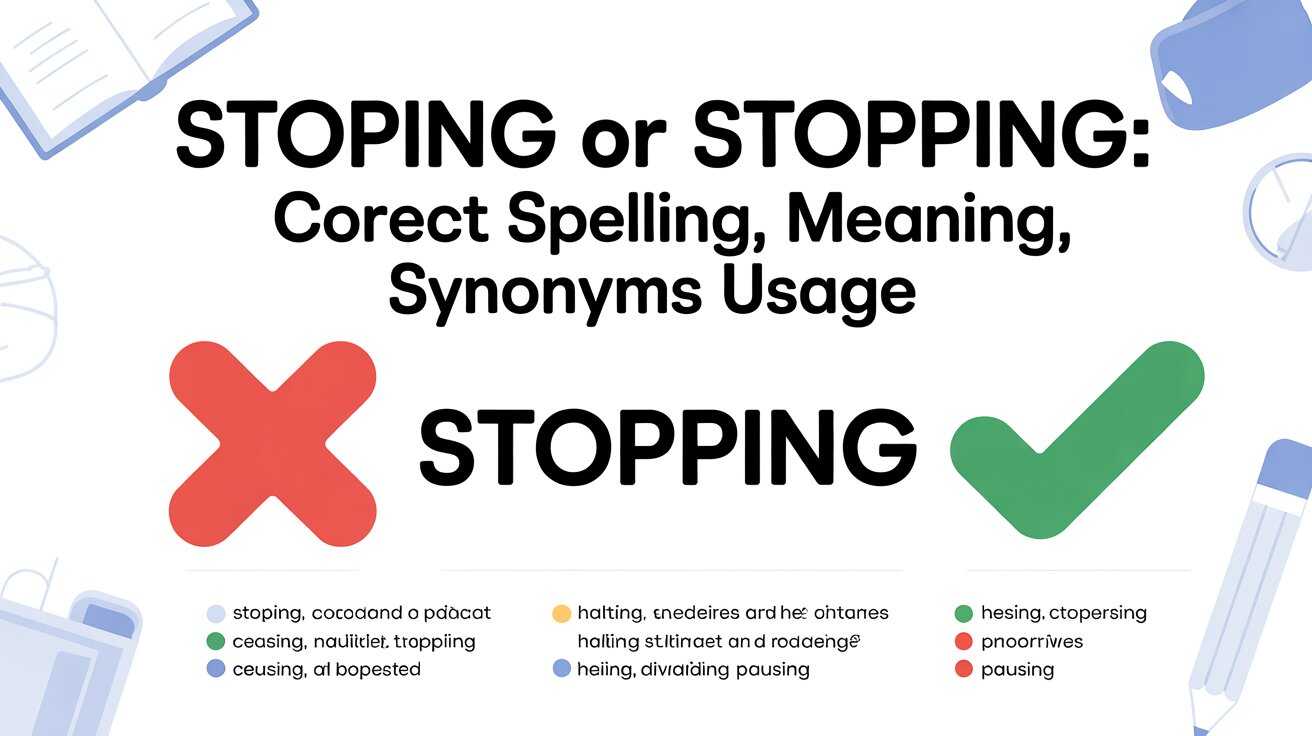
When learning English spelling and grammar, one of the most common questions learners ask is “is it stoping or stopping?” This guide will explain stoping or stopping meaning, show you stoping or stopping which is correct, explore synonyms, and even look at special technical usages where stoping can be a real word. By the end, you’ll have a clear understanding of this topic and how to use it correctly in writing and speech.
Introduction: Stoping or Stopping – Which Should You Use?
Stoping or stopping is a question rooted in English spelling rules and word usage. Most people wonder “is it stoping or stopping?” because when adding -ing to verbs like stop, it’s easy to make mistakes if you don’t know the correct grammar rules. The short answer is that stopping is the correct form when you mean the action of ceasing something, while stoping is spelled differently and rarely used except in technical fields like mining. This article will explore both words, their meanings, synonyms, correct usage, and examples so you never get confused again.
What Does “Stopping” Mean?
Stopping is the present participle of the verb stop, meaning the act of ceasing, halting, or bringing something to an end. This form is used when describing an ongoing action or state. For example, “she was stopping the car at the red light” uses stopping to show an action in progress.
In grammatical terms:
- Stopping is used when a verb ends in a single consonant after a short vowel sound, and -ing is added.
- The consonant is doubled — stop → stopping — to preserve the short vowel sound.
Because of this rule, stopping is the standard and correct spelling when you mean to express the action of stopping something.
What “Stoping” Means
Unlike stopping, stoping is a real word in very specific contexts — but not as a verb in standard English. The term stoping is primarily used in mining and geology to describe the process of removing ore and creating an open space in an underground mine.
In mining engineering:
- Stoping refers to extracting mineral ore from underground, leaving a void known as a stope.
- Different methods of stoping include room-and-pillar, cut-and-fill, and longhole stoping.
So if someone asks “is it stoping or stopping as past tense?”, the answer is that stoping is not the correct participle form of stop in everyday English, but it does have a technical meaning within mining.
Why “Stopping” Is Correct – Grammar Rules Explained
English grammar rules for adding -ing often confuse learners, but once you know the pattern, it becomes easy:
- Base word ends in consonant-vowel-consonant (CVC): When a one-syllable word ends in this pattern (like stop), the final consonant doubles before adding -ing.
- Short vowel sound rule: Doubling preserves the short o sound in stop. Without doubling, stoping would imply a longer vowel or change in pronunciation, which is not correct.
- Compare with false example: Saying stoping in place of stopping is like saying hoping as hopping. Because stop follows the grammatical rule for doubling, stopping is correct.
This rule also applies to other words — run becomes running, sit becomes sitting, and so on.
Synonyms for “Stopping” and Related Words
If you’re curious about stoping or stopping synonym usage, here’s a human-friendly list of words that have similar meanings or can replace stopping in certain contexts:
Action-related synonyms:
- Halt – to bring something to a close
- Cease – to stop gradually
- Pause – to stop temporarily
- Discontinue – to end a repeating action
- End – to bring something to a full close
Each synonym carries a slightly different nuance. For example, halt suggests sudden interruption, while cease often sounds more final.
Stoping vs Stopping – Example Sentences That Clarify Usage
Seeing real sentences helps understand the difference between stoping or stopping:
| Sentence | Correct? | Notes |
|---|---|---|
| I was stoping the car. | ❌ | Incorrect – tries to use stoping as the verb form |
| I was stopping the car. | ✅ | Correct – proper present participle |
| The miners were stoping ore deep underground. | ✅ | Correct – technical mining term |
| She was stoping her speech. | ❌ | Incorrect – everyday English doesn’t use stoping |
| The train was stopping at every station. | ✅ | Correct – standard usage |
Common Misconceptions About Stoping vs Stopping
Many learners of English, and even some native speakers, often confuse stoping vs stopping because of the spelling and pronunciation similarities. Here are some common misconceptions:
- Misconception 1: “Stoping is just a simpler spelling of stopping.” Reality: Stoping is not a correct participle form in everyday English. It’s only correct in technical mining contexts.
- Misconception 2: “Doubling the consonant isn’t important.” Reality: English grammar rules require doubling the consonant in words ending with a single consonant after a short vowel (CVC pattern). Writing stoping instead of stopping changes the word and is grammatically incorrect.
- Misconception 3: “Stoping is acceptable in informal writing.” Reality: Even in informal writing, stopping is the correct spelling. Using stoping can appear as a spelling mistake and affect readability.
Key takeaway: Knowing the rule and examples ensures you never mix up these two words, and you always use stopping correctly in general English.
Regional Differences in Spelling and Usage
While stopping is universally correct in everyday English, there are minor differences in English usage across regions that learners should know:
- British English:
- Always doubles the consonant for CVC verbs.
- Example: stopping, running, getting — correct in both British and American English.
- The pronunciation remains consistent, and stoping is never used outside technical contexts.
- American English:
- Follows the same CVC rule for doubling the consonant.
- Spelling remains stopping.
- Some informal shortcuts like texting or casual writing may omit doubling, but these are considered incorrect in formal writing.
- Mining Exception Worldwide:
- In technical literature or mining engineering manuals, stoping is used internationally to describe ore extraction.
- Example: The miners began stoping to create a new stope.
Key takeaway: Outside of specialized technical or mining contexts, stopping is the correct spelling in all English-speaking regions.
Tips for Teaching or Learning the Difference
For English learners or teachers, understanding and remembering the difference between stoping or stopping can be simplified with practical tips:
- Use the CVC Rule as a Memory Tool:
- Check if a verb ends in Consonant-Vowel-Consonant. If yes, double the final consonant before adding -ing.
- Example: stop → stopping, run → running.
- Visual Learning:
- Write example sentences with both stopping and stoping and highlight the incorrect forms in red to reinforce the correct usage visually.
- Practice With Synonyms:
- Use synonyms like halt, pause, cease in sentences to reinforce meaning and context.
- Example: She was halting the car → She was stopping the car.
- Mini Quizzes:
- Ask learners to fill in blanks: “I am ___ the car” → stopping
- Include mining examples separately: “The miners were ___ the ore” → stoping
- Use Spaced Repetition:
- Review the rule and examples regularly over days or weeks to reinforce the memory.
Key takeaway: Combining grammar rules, visual examples, and repetitive practice ensures learners confidently use stopping correctly and understand the technical use of stoping.
How to Remember the Difference Easily
When in doubt between stoping or stopping, the following tips help:
- Think of the doubling rule: If you’re adding -ing to make a verb progressive, check if the base word is CVC. If so, double the final consonant.
- Remember the mining exception: If discussing ore extraction in mining, stoping is valid but very specialized.
- Practice with examples: Sentences like “stopping the car,” “stopping the conversation,” and “stoping rock in a mine” show the correct context for each word.
Using these memory tricks keeps your writing error-free.
Case Study – Common Mistakes Writers Make
Many learners and even native speakers make stoping vs stopping errors because they don’t apply the doubling rule. Grammar tools sometimes mislead users into believing stoping is correct because it looks simpler. Studies of writing samples show:
- Most corrections involve changing stoping to stopping.
- Tools highlight the need to double consonants in CVC + ing words.
- Learners often write “I am stoping here,” which is marked incorrect.
FAQs – Clear Answers to Common Questions
Q1: Is it stoping or stopping? A1: In everyday English, stopping is correct. Stoping is mostly incorrect except in mining.
Q2: What is the stoping or stopping meaning? A2: Stopping means halting or pausing an action. Stoping refers to ore extraction in mining.
Q3: What is a good stoping or stopping synonym? A3: Synonyms include halt, cease, pause, discontinue, and end, depending on context.
Q4: Why do we double the p in stopping? A4: Because stop ends in a consonant-vowel-consonant pattern, and doubling keeps the vowel sound short.
Conclusion
So, is it stoping or stopping? For everyday English usage, stopping is correct every time. The form stoping appears only in specialized mining language. Understanding grammar rules, synonyms like halt and cease, and seeing example sentences helps you use stoping or stopping confidently and correctly. Remember: stopping for actions, stoping for mining. Following these tips ensures your writing is clear, accurate, and professional.
Do you want me to do that next?