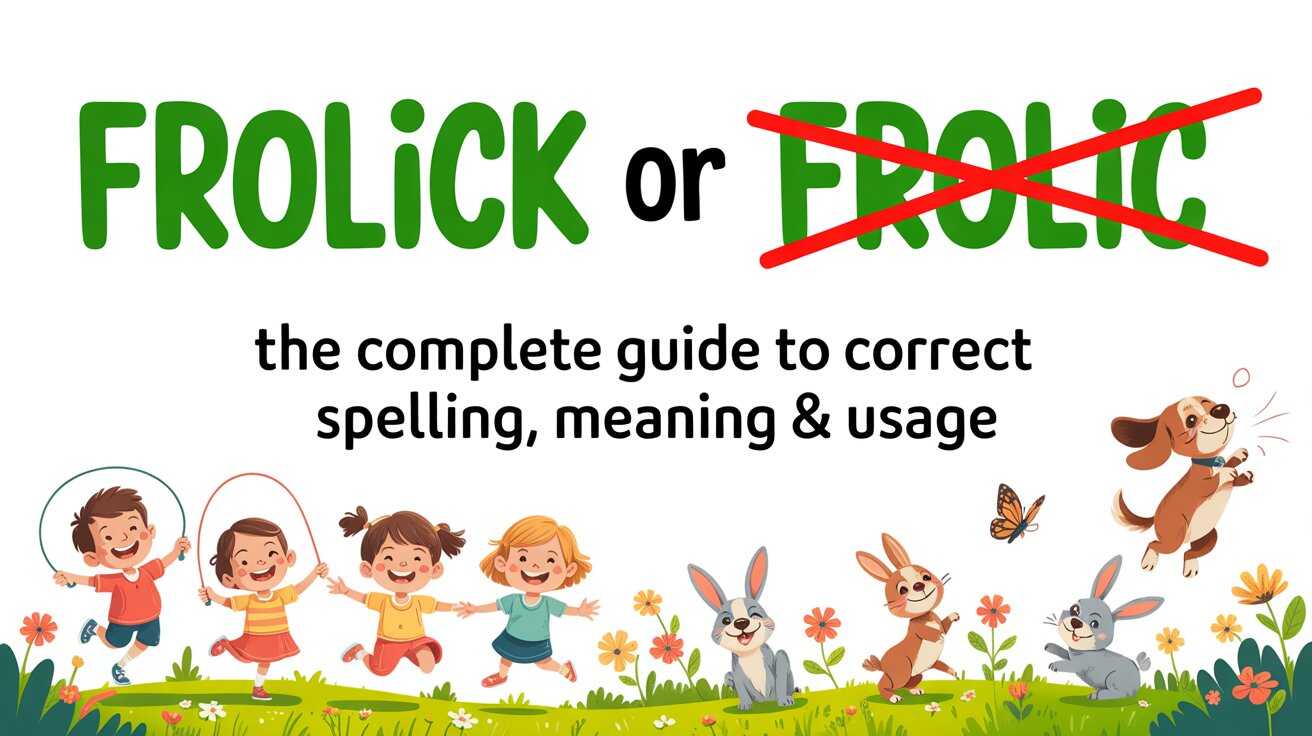
Frolick or frolic — if you’ve ever wondered which spelling is correct, why the confusion exists, and how to use this word confidently in sentences, you’re in the right place. In this comprehensive guide, we’ll explore frolic vs frolick, dive into meanings, examples, grammar rules, and sentence usage, and answer all the questions English learners and writers often ask.
Let’s clear the confusion once and for all and help you master this word with clarity and confidence.
What Does Frolic Mean?
The word frolic is an English term that describes playful, lively behavior. It can be used both as a verb (an action) and as a noun (a thing or event).
In simple terms:
- As a verb: To play or romp around in a cheerful way.
- As a noun: A playful activity or lighthearted fun.
Think of kids running joyfully in a field, puppies chasing butterflies, or friends laughing and dancing on a sunny afternoon — that’s frolic in action.
Here are a few everyday examples of frolic used properly:
- “The puppies frolic in the yard every morning.”
- “Their afternoon picnic turned into a spontaneous frolic.”
- “We watched the children frolic near the riverbank.”
Why the Confusion? Frolic or Frolick?
One reason many people end up searching for “frolic or frolick” is because of how the word appears in everyday speech. Sometimes, writers or speakers mistakenly add a ‘k’ at the end of the base word, leading to the non‑standard variant “frolick.”
So let’s compare:
| Spelling | Status | Notes |
|---|---|---|
| frolic | ✔️ Correct | The standard, dictionary‑accepted spelling |
| frolick | ❌ Incorrect | A common mistaken version many people use |
This comparison highlights the truth behind frolick vs frolic. Despite what you might see in informal writing or some online texts, “frolic” is the only correct spelling in standard English.
People often ask, “Is frolick a real word?” The short answer is no — in formal, academic, or dictionary English, “frolick” doesn’t exist as a valid entry. What people are usually thinking of instead is “frolicked” or “frolicking” — correct inflected forms of frolic.
Frolick vs Frolic — Spelling Rules and Word Forms
To understand the difference between frolic vs frolick, it helps to look at how words change in English.
Inflected Forms (Verb Conjugations)
| Base Word | Present Progressive | Past Tense |
|---|---|---|
| frolic | frolicking | frolicked |
Even though the base word is frolic, when we form certain verb tenses, we add a k before the ending. This is a standard rule in English for words ending in ‑lic when creating ‑ing or ‑ed forms:
- to frolic → frolicking
- frol‑ic → frolicked
This can be confusing at first glance — and it’s precisely why people mistakenly think the base spelling might be frolick. But the base word remains frolic, and the expanded forms simply follow spelling conventions to help with pronunciation.
Frolic vs Frolick – Everyday English Usage
Understanding how the word functions in real sentences is essential. Below are clear, human‑friendly examples to help you see the difference between proper and improper use.
Correct Usage Examples
- As a verb:
- “The children love to frolic in the autumn leaves.”
- “You could see them frolic by the lakeside all afternoon.”
- As a noun:
- “Their friendly frolics brightened up the gloomy day.”
- “A quick frolic in the meadow lifted everyone’s spirits.”
Incorrect Usage to Avoid
- “They like to frolick in the rain.” ❌ (This seems plausible, but “frolick” is not a standard form.)
Always use frolic as the base word and let grammar rules shape the correct form (e.g., mantaining “c” before “‑ing” and “‑ed”).
READ MORE >>> nosey or nosy — Which Spelling Is Correct? A Complete Guide
Real‑Life Examples: How to Use Frolic in Sentences
Good examples help you apply words correctly. Below are examples tailored to real writing scenarios:
Formal Writing
- “The report recorded how infants frolic more often during unstructured playtime.”
Informal Conversations
- “We spent the afternoon hiking and then frolic on the grass at sunset.”
Emails or Blogs
- “Here are some ideas to help your dog frolic safely outdoors.”
These illustrate a range of usage contexts — from academic to casual, from blogs to personal emails.
British vs American English — Does the Usage Change?
When it comes to frolic vs frolick, both British and American English use the same correct base form: frolic.
There’s no regional variation where “frolick” is considered standard. While pronunciation and accent may differ between regions, the spelling stays the same.
In other words, whether you’re writing for a British readership or an American audience, frolic remains the acceptable form.
Common Mistakes and How to Avoid Them
English learners, and even native speakers, sometimes fall into patterns like:
- Using frolick as the base word
- Misplacing tense forms
- Confusing frolic with related words such as rollick
Here are some simple tips to avoid these pitfalls:
- Begin by memorizing the base word: frolic
- Understand that adding ‑ing or ‑ed changes the spelling for pronunciation reasons (frolicking, frolicked)
- Read example sentences to internalize natural usage
Remember: the difference between frolick vs frolic isn’t a trick — it’s just a matter of understanding English word formation rules.
Synonyms and Related Words
Expanding your vocabulary around frolic can deepen understanding and help with more expressive writing. Here are some synonyms that capture similar playful meanings:
- romp — a lively, energetic play
- cavort — to leap or dance about joyfully
- gambol — playful skipping or frolicking
- rollick — cheerful, carefree movement
While these words have slightly different tones or emphases, they share the playful energy associated with frolic.
Why Frolic Matters for English Learners
If you’re learning English as a second language (ESL), mastering the correct spelling and usage of words like frolic can be a major confidence booster.
Understanding common spelling rules — and the difference between base words and inflected forms — lays the groundwork for better grammar in writing and speaking. So next time you write a story, email, or academic essay, you’ll know exactly when frolic is correct and when a different form like frolicking is needed.
FAQ: Frolick or Frolic
Below are common long‑tail questions people search related to frolick or frolic, along with clear answers.
Q: Is frolick a real word? A: Not as a base word in standard English. The correct base form is frolic.
Q: Which spelling is correct — frolic or frolick? A: Frolic is correct for the base word. Frolicking and frolicked are correct derivative forms.
Q: Can frolic be used as a noun? A: Yes. For example: “Their afternoon was full of frolic.”
Q: Why does frolicking have a “k”? A: The “k” is added to maintain consonant sound rules when forming ‑ing and ‑ed.
Q: What’s the difference between frolic and rollick? A: Both imply playful activity, but rollick emphasizes hearty, carefree fun.
Final Thoughts — Frolick or Frolic?
To summarize, whenever you’re faced with the choice of frolic or frolick, the correct answer is frolic — without the extra k — for the base word in standard English.
Understanding this distinction helps you write with confidence, avoid common mistakes, and communicate more clearly. Whether you’re writing essays, emails, blogs, or poems, this knowledge strengthens your grasp of English vocabulary.
Remember that while derivative forms like frolicking and frolicked correctly include a k, the foundation remains frolic.