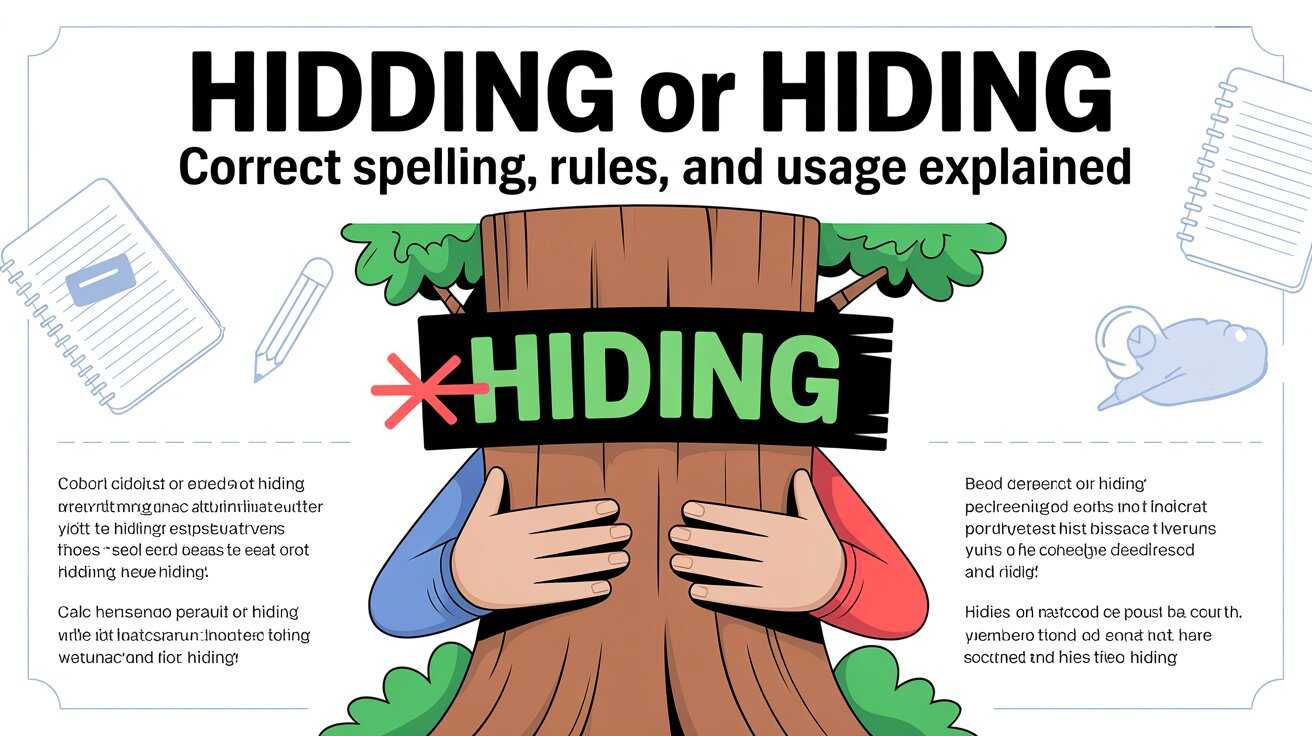
Hidding or hiding is a common English spelling question. The correct spelling is hiding, not hidding. The word follows the silent-e rule: when a verb ends with a silent “e,” drop it before adding “-ing.” Hiding is the present participle of hide and is used in sentences like “She is hiding behind the door.” “Hidding” is never standard in modern English.
⚡ Quick Answer
Quick Answer: The correct spelling is hiding. Use it when forming the present participle of the verb hide. Hidding is always incorrect. Remember: drop the silent “e” before adding “-ing.” For example: “The cat is hiding under the couch.”
📘 What Does “Hiding” Mean?
Simple Definition
Hiding is the present participle of the verb hide. It describes the action of putting something or oneself out of sight, either physically or metaphorically.
Micro-example:
- “The children are hiding during a game of hide-and-seek.”
- “She is hiding her feelings about the project.”
Usage in Sentences ✅ Examples
- He is hiding the gift behind his back.
- The dog is hiding under the table during the thunderstorm.
- They were hiding from the surprise inspection.
Pro tip: Context matters — hiding can be literal (physical concealment) or figurative (emotions, thoughts).
📎 Why “Hidding” is Incorrect
Silent E Rule Explanation 🔥
English spelling has a consistent pattern for verbs ending with a silent “e”:
- Identify the silent “e” at the end of the base verb.
- Drop the “e” before adding “-ing.”
Rule in action:
| Base Verb | Incorrect | Correct |
|---|---|---|
| hide | hidding | hiding |
| make | making | making |
| write | writing | writing |
Key insight: “Hidding” breaks this rule and is never standard in modern English.
Common Learner Mistakes ✅ Mini Case Study
Scenario: An ESL student submits an essay that reads:
“The fox is hidding in the forest.”
Problem: The student used “hidding” instead of “hiding.”
Consequences:
- Teacher marks it as incorrect.
- Sentence meaning is clear, but spelling credibility is lost.
- Highlights need for grammar rule reinforcement.
Lesson: One letter can affect correctness, authority, and clarity.
READ MORE >>> Paster or Pastor: What’s the Difference and Which Spelling Is Correct?
🧠 Verb Forms of Hide
Table: Hide Verb Forms ✅ Table Placement
| Base Verb | Past Simple | Past Participle | Present Participle |
|---|---|---|---|
| hide | hid | hidden | hiding |
Micro-example:
- “Yesterday, he hid behind the tree, but today he is hiding behind the couch.”
Gerund vs Present Participle 🔥
- Present participle: describes ongoing action. “He is hiding the documents.”
- Gerund: functions as a noun. “Hiding can be fun in games like hide-and-seek.”
Expert tip: Understanding the difference improves sentence variety and grammatical accuracy.
🔊 Pronunciation Guide for Hiding
Phonetic Spelling
- IPA: /ˈhaɪ.dɪŋ/
- Phonetic: HYE-ding
Pronunciation Tips for ESL Learners ✅ Expert Tips Placement
- Stress the first syllable: HYE-ding
- Avoid doubling the “d” sound
- Practice with minimal pairs: hide vs hid vs hiding
⚠️ Memory Tricks to Remember Hiding vs Hidding
Easy Mnemonic
- Drop the “e” in hide before adding “-ing.”
- Think: “HIDE → HIDING, never HIDDING.”
Visual Memory Hack
Imagine a cat slipping behind a curtain. The “e” in hide disappears like the cat — leaving only hiding.
✍️ Rules for Adding -ing to English Verbs
Vowel-Consonant Patterns 🔥
- For one-syllable verbs ending in a single consonant after a single vowel, double the consonant:
- run → running
- sit → sitting
- For verbs ending with silent “e,” drop the “e”:
- hide → hiding
- make → making
Silent E Rule Recap ✅ Table Placement
| Verb | Correct -ing | Explanation |
|---|---|---|
| hide | hiding | Drop silent e |
| bake | baking | Drop silent e |
| love | loving | Drop silent e |
💡 Expert Writing Tips to Avoid Spelling Mistakes
Proofreading Checklist ✅ Expert Tips Placement
- Look for silent “e” endings before adding “-ing.”
- Check for double consonant rules.
- Use spell check but verify manually.
Tips for ESL Learners
- Practice with common verbs: make, hide, write, bake
- Repeat writing and speaking exercises
- Use mnemonic devices to reinforce rules
Historical Evolution of “Hidding” in English
While “hidding” is considered incorrect today, historical English texts sometimes show this spelling. In Middle English, spelling was not standardized, so writers often used variations like “hidding” for the present participle of hide. Over time, the silent-e rule became standard, and “hiding” replaced “hidding” in formal and modern writing.
Micro-example from literature:
- In a 16th-century manuscript, one might see: “He was hidding from his master in the forest.”
- Today, this would be corrected to: “He was hiding from his master in the forest.”
Takeaway: Understanding this evolution helps ESL learners recognize why “hidding” might appear in old texts but is never correct in modern usage.
How Spellcheck and Autocorrect Can Mislead You
Many writers rely on digital tools for spelling, but these tools are not infallible. Spellcheck may not flag “hidding” if it is included in a dictionary or as a suggested alternative. Similarly, autocorrect can sometimes replace correctly typed words with incorrect suggestions if the software predicts typing patterns incorrectly.
Tips to avoid mistakes:
- Double-check grammar rules — don’t rely solely on software.
- Cross-reference with authoritative dictionaries like Oxford or Merriam-Webster.
- Practice writing sentences manually to internalize correct spelling.
Micro-example:
- Typing: “He is hidding the gift” → autocorrect may leave it unchanged.
- Correct: “He is hiding the gift”
Expert tip: Even when tools suggest corrections, always verify with grammar knowledge. This strengthens writing authority and avoids repeated errors.
Fun Exercises to Practice Spelling “Hiding” Correctly
Practical exercises help reinforce the spelling of hiding and other verbs with silent-e endings. Here’s a mini activity set for learners:
1. Fill-in-the-Blank Exercise
- He is __ behind the tree. (Answer: hiding)
- She is __ her feelings. (Answer: hiding)
2. Multiple Choice
Which is correct? a) hidding b) hiding c) hiddding
(Correct: b) hiding)
3. Verb Table Practice
| Base Verb | Add -ing | Correct Spelling? |
|---|---|---|
| make | making | ✅ correct |
| hide | hidding | ❌ incorrect |
| bake | baking | ✅ correct |
4. Real-life Sentence Creation
Ask learners to write 3 sentences using “hiding”, one literal, one figurative, and one creative example.
Key point: These exercises train muscle memory, helping learners internalize rules like dropping the silent e while keeping learning fun and interactive.
❓ Frequently Asked Questions (PAA Target Section)
1. Is it hidding or hiding?
Answer: Always hiding. “Hidding” is incorrect in modern English.
2. Why is hiding spelled with one “d”?
Answer: The silent-e in hide is dropped before adding “-ing.” Doubling the “d” is unnecessary.
3. When do you double consonants in English?
Answer: For one-syllable verbs with a single vowel followed by a consonant (run → running, sit → sitting). “Hide” doesn’t follow this rule, so we don’t double the “d.”
4. Is hiding a gerund or participle?
Answer: Both. As a gerund, it functions as a noun (“Hiding is fun”). As a participle, it shows ongoing action (“He is hiding behind the tree”).
5. Can hidding ever be correct?
Answer: No. “Hidding” is never standard in modern English writing. Only historical texts or typos may show it.
🏁 Final Verdict and Usage Guidelines
- Correct spelling: hiding
- Rule: drop the silent “e” before adding -ing
- Common errors: doubling consonants unnecessarily
- Tip: Use verb tables and memory hacks to avoid mistakes
- Real-world advice: In academic, business, or casual writing, always use hiding to maintain correctness and credibility