Is good morning one word? No—“good morning” is written as two words in standard English. It’s a polite greeting phrase made from an adjective (good) and a noun (morning). But because we write “goodnight” as one word, many people naturally wonder if good morning should also be combined into one word (goodmorning) or hyphenated (good-morning).
This guide clears up every confusion in a simple, practical way—with real examples, email formats, grammar rules, punctuation tips, and a comparison table—so you can confidently write it correctly in every situation.
Quick Answer (Featured Snippet)
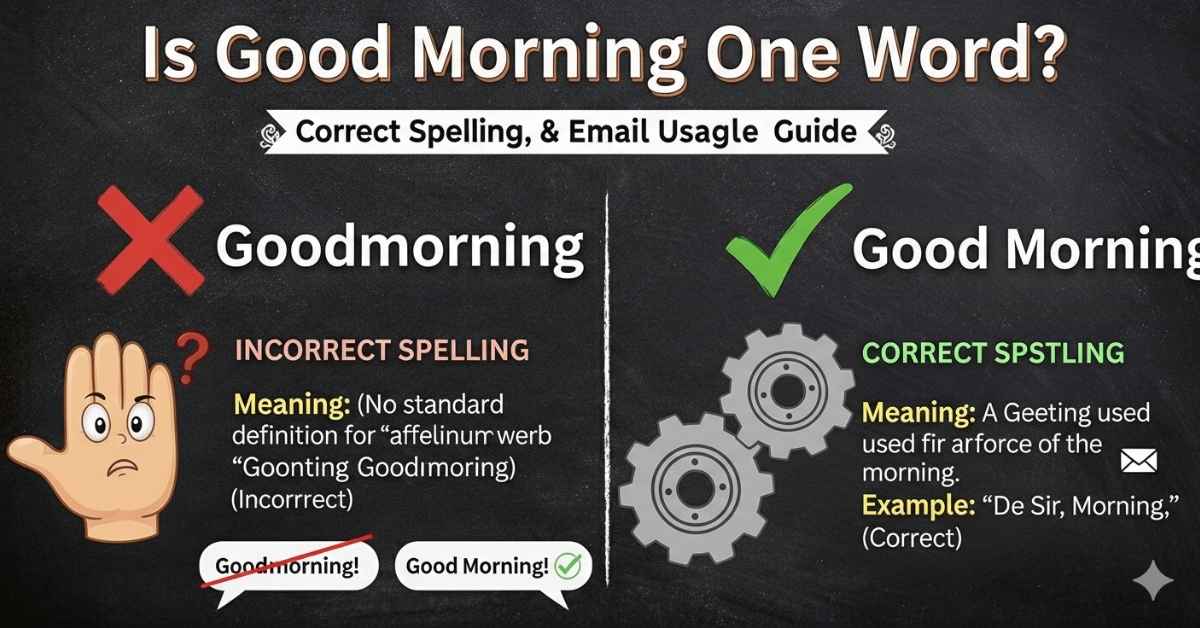
✅ Correct: good morning (two words) ❌ Incorrect: goodmorning (one word) ⚠️ Rare/Not standard: good-morning (hyphenated)
If you’re searching “is good morning one word or 2”, the correct answer remains the same: it is two words.
Is Good Morning One Word or 2? (The Most Common Confusion)
Many people type queries like:
- is good morning one word or 2
- is good morning one word or two
- is good morning one word or two words
- is good morning one word or two words in email
These searches happen because English is not fully consistent with greetings and compounds. Some expressions evolve into a single word over time (like goodbye or goodnight), while others stay open (two separate words), like good morning and good afternoon.
Is good morning one word or two words in modern English?
In modern English, “good morning” remains two words because it’s an open compound (a phrase that stays separated). This is also why we write:
- good morning
- good afternoon
- good evening
…and not goodafternoon or goodevening.
So, if your question is “is good morning one word or two words?” the answer is:
✅ Two words: good morning
Why “Good Morning” Is Two Words (Simple Grammar Explanation)
Let’s break it down with a grammar rule that’s easy to remember.
“Good” + “Morning” = adjective + noun
In the phrase good morning:
- good = adjective (describes)
- morning = noun (the time of day)
So it works like:
✅ good (adjective) + morning (noun) = greeting phrase
This pattern is extremely common in English:
- good day
- good evening
- good night (can be two words as well)
Is “good morning” a phrase or a single word?
It’s a phrase, not a single word. Specifically, it functions as a greeting—often like an interjection (a spoken expression).
Examples:
- Good morning! (interjection/greeting)
- She said good morning politely. (noun phrase inside sentence)
This is why writing goodmorning as one word is a misspelling in standard writing.
Why Is “Goodnight” One Word but “Good Morning” Isn’t?
This is one of the biggest reasons people ask: “Why is goodnight one word but good morning two words?”
The answer is both linguistic and practical.
1) “Goodnight” works like a farewell
Goodnight is commonly used as a farewell at the end of the day—similar to:
- goodbye
- goodnight
Farewells tend to become fixed expressions, and fixed expressions are more likely to become compound words over time.
2) “Good morning” stays as a time-based greeting
Good morning is tied to a specific time of day and is used as a greeting at the start of the day.
We don’t combine these time-based greetings into one word:
- good morning ✅
- good afternoon ✅
- good evening ✅
Quick comparison
- Goodnight → a closing expression; became more “set”
- Good morning → a phrase describing morning greeting; stayed open
That’s why the spelling is different.
Quote: “English spelling often reflects usage over time. Some phrases become fixed compounds, while others remain open.” This explains why “goodnight” and “good morning” don’t follow the same pattern.
Correct Capitalization: Good morning vs Good Morning
A lot of people don’t only ask about spelling—they ask about capitalization too.
Let’s make it simple.
When should you capitalize “good morning”?
✅ You capitalize Good morning when:
- It starts a sentence
- It’s used as a greeting at the start of a message
- It appears in a heading/title
Examples:
- Good morning, Ayesha.
- Good morning! I hope you slept well.
- Good Morning Messages for Friends (title)
When should you write “good morning” in lowercase?
✅ Use lowercase good morning when it’s not starting the sentence:
- She wished me good morning before leaving.
- They said good morning and smiled.
IMPORTANT: “Good Morning” (both words capitalized) is often used for aesthetic purposes in titles, but in normal sentences, use proper sentence rules.
Punctuation Rules: Should There Be a Comma After “Good morning”?
This is a small detail—but it makes your writing look much more professional.
Rule: Use a comma when addressing someone
✅ Correct:
- Good morning, Sarah.
- Good morning, team.
- Good morning, everyone.
Here, “Sarah/team/everyone” is a direct address, so the comma is required.
What if you don’t address anyone?
Then you can write:
- Good morning!
- Good morning.
Good morning in dialogue
✅ Correct examples:
- “Good morning, Doctor,” she said.
- He nodded and replied, “Good morning.”
IMPORTANT: Correct punctuation adds clarity—and helps avoid looking careless in professional communication.
Is Good Morning One Word in Email? (Correct Email Format)
Now let’s answer the exact query: is good morning one word in email?
✅ No—it remains two words in emails as well.
But emails have extra rules: comma placement, capitalization, and professionalism.
The best email greeting format
Here are safe and correct email openings:
- Good morning, [Name],
- Good morning, Sir/Ma’am,
- Good morning, team,
- Good morning, everyone,
Example:
Good morning, Mr. Khan, I hope you’re doing well. I’m writing to follow up on…
This format is considered formal, clean, and grammatically correct.
Why email greetings are so important
In professional communication, greetings set your tone. A correct greeting shows:
- respect
- clarity
- confidence
- good writing skills
If you write Goodmorning in an email, it can look like a typo—even if the rest of your email is perfect.
When NOT to Use “Good Morning” in Emails (Time Zone Problem)
Here’s a detail many articles skip, but it’s extremely useful.
If you email someone in a different time zone, your “Good morning” might arrive at:
- 4 PM
- late evening
- midnight
In that case, a safer greeting is:
- Hello [Name],
- Hi [Name],
- Greetings,
This is especially helpful for international or remote work communication.
Real-Life Examples: Correct vs Incorrect Usage
Let’s make the difference crystal clear.
✅ Correct examples
- Good morning! How are you today?
- Good morning, Ali. Are you ready for the meeting?
- She said good morning and walked away.
- Good morning, everyone, let’s begin.
❌ Incorrect examples
- Goodmorning, Ali. ❌
- Good-Morning everyone ❌
- goodmorning ❌
WhatsApp / SMS examples
Even in informal messages, keep spelling correct:
- Good morning 😊
- Good morning! Have a great day
- Good morning, bestie 🌸
You can be casual without misspelling.
Is “Good Morning” Hyphenated? (Good-morning)
Another common confusion is hyphenation.
Is good-morning correct?
Generally, no. In everyday writing, good-morning is not standard.
However, hyphenation can sometimes appear when a phrase is used as an adjective before a noun.
Example (rare but possible in certain writing styles):
- a good-morning message
- the good-morning greeting
Even then, many writers prefer:
- a good morning message
- the good morning greeting
So for most readers and most SEO content:
✅ Use: good morning ❌ Avoid: good-morning
Common Mistakes People Make (And How to Fix Them)
Let’s cover the top errors that create confusion.
1) Writing “goodmorning” as one word
This is a common typo and should be avoided.
✅ Correct: good morning ❌ Incorrect: goodmorning
2) Over-capitalization
Some people write:
- GOOD MORNING
- Good Morning (in regular sentence)
This isn’t wrong in design contexts, but in writing:
✅ Use sentence rules:
- Good morning, John.
- She said good morning.
3) Missing comma in greeting
A very common email mistake:
❌ Good morning John, ✅ Good morning, John,
4) Confusing it with “goodnight”
Remember:
- good night ✅ (two words)
- goodnight ✅ (one word; common farewell)
- good morning ✅ (two words)
READ MORE >>> Puting or Putting: Correct Spelling, Meaning & Golf Use
Good Morning vs Goodmorning vs Good-morning (Correct Form)
| Form | Correct? | Where it’s used | Notes |
|---|---|---|---|
| good morning | ✅ Yes | Greeting | Standard, correct spelling |
| Good morning | ✅ Yes | Start of sentence/email | Capitalize first word |
| Good Morning | ✅ Yes (context-based) | Titles/headings | Often stylistic |
| goodmorning | ❌ No | — | Common misspelling |
| Goodmorning | ❌ No | — | Incorrect form |
| good-morning | ⚠️ Rare | As adjective (rare) | Not standard in everyday writing |
Mini Case Study: Why Correct Spelling Matters in Professional Writing
Imagine two job applicants emailing HR:
Email A:
Goodmorning, Sir I am applying for the position…
Email B:
Good morning, Sir, I’m writing to apply for the position…
Even without reading further, Email B feels:
- more polished
- more educated
- more trustworthy
FAQs: Is Good Morning One Word or Two Words?
Is good morning one word or two words?
✅ It is two words: good morning.
Is good morning one word or 2?
No. Even if you shorten the question as “is good morning one word or 2”, the answer stays the same: two words.
Is good morning one word or two?
✅ Two words: good morning.
Is good morning one word in email?
No. In emails, it is still written as good morning (two words), usually followed by a comma: Good morning, [Name],
Is “Goodmorning” ever correct?
In standard English writing, no—it’s treated as a misspelling.
Should there be a comma after “Good morning”?
✅ Yes, if you address someone directly: Good morning, Ali.
What can I write instead of good morning in email?
You can use:
- Hello [Name],
- Hi [Name],
- Greetings,
These are especially useful when time zones make “good morning” uncertain.
Final Verdict
Let’s end it clearly:
✅ Good morning is not one word. ✅ The correct spelling is two words: “good morning.” ✅ In emails, the correct format is: Good morning, [Name], ❌ Avoid goodmorning and good-morning in normal writing.