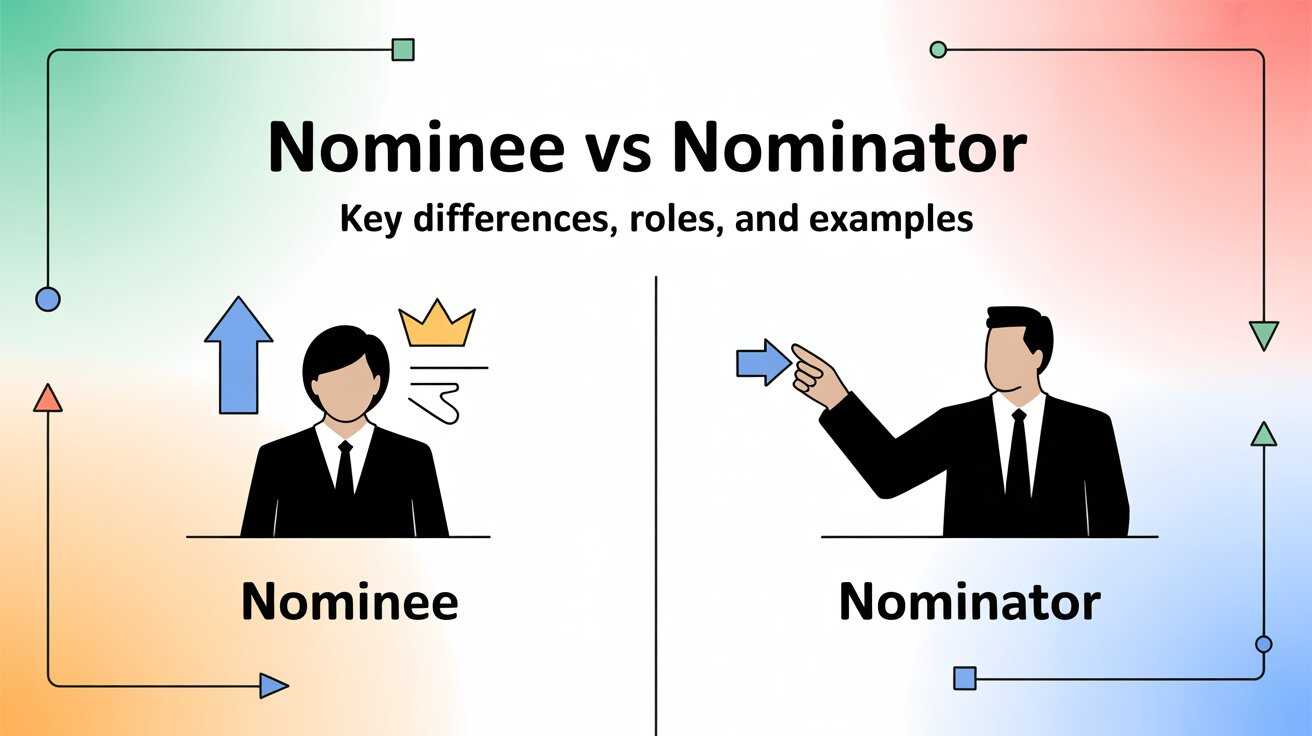
Understanding nominee vs nominator can be tricky if you’re new to awards, elections, or corporate processes. Many people confuse these terms or use them interchangeably. In reality, the nominator is the person proposing someone for a role, award, or position, while the nominee is the individual being proposed. Let’s dive deeper into their roles, responsibilities, and how to use them correctly.
Quick Answer
A nominator is the person who recommends or proposes someone for an award, position, or role. A nominee is the individual being proposed or considered. Simply put, the nominator takes action, while the nominee receives it. Both roles are essential in awards, elections, corporate boards, scholarships, and legal processes.
| Term | Role / Definition |
|---|---|
| Nominator | Person who recommends or proposes |
| Nominee | Person being recommended or considered |
What Is a Nominator?
Definition of Nominator
A nominator is someone who proposes, recommends, or puts forward a candidate for a specific role or recognition. They hold the responsibility to select qualified individuals and submit their names for consideration. Think of a nominator as the initiator in the nomination process.
Example:
In a corporate award program, the team leader nominates their top-performing employee for “Employee of the Year.”
Responsibilities of a Nominator
A nominator isn’t just a name-submitter. Their responsibilities include:
- Evaluating potential candidates carefully
- Ensuring the nominee meets eligibility criteria
- Providing supporting evidence or justification for nomination
- Following formal submission procedures
Expert Tip: Always verify eligibility before nominating someone to avoid disqualification.
Common Mistakes Nominators Make
- Nominating without approval: Submitting a nomination without confirming eligibility.
- Confusing roles: Acting as both nominator and nominee inappropriately.
- Incomplete information: Missing supporting documents or evidence.
Micro-example:
A manager nominated an employee without confirming they met tenure requirements. The nomination was rejected.
Contextual Examples of Nominators
- Awards: Teachers nominating students for academic excellence.
- Elections: Committee members nominating candidates for leadership roles.
- Corporate promotions: HR managers nominating employees for internal recognition.
Nominator in Legal & Corporate Contexts (Information Gain)
In corporate law, nominators may propose nominee directors or nominee shareholders. Here, the nominator must understand legal responsibilities, eligibility, and conflict-of-interest rules.
Mini Case Study:
In a startup board, the majority shareholder acted as the nominator to appoint a nominee director. The nominee’s role was strictly defined in the shareholder agreement, ensuring corporate governance and compliance with legal standards.
READ MORE >>>> Panel vs Pannel: Meaning, Correct Spelling, and Usage Guide
What Is a Nominee?
Definition of Nominee
A nominee is the individual being proposed or considered for a role, award, or position. They do not act in the nominating capacity; rather, they receive consideration.
Example:
Emily was nominated for “Best Innovator of the Year” by her department head. Emily is the nominee.
Duties and Expectations of a Nominee
Nominees may have responsibilities depending on context:
- Accept or decline the nomination formally
- Prepare any required documentation or presentation
- Maintain ethical standards during consideration
Expert Tip: Respond promptly to nominations to maintain credibility and professional reputation.
Common Misunderstandings About Nominees
- Not all nominees accept: Some may decline for personal or professional reasons.
- Nominee ≠ winner: Being nominated doesn’t guarantee selection.
- Nominee ≠ candidate always: A nominee may simply be proposed for consideration.
Micro-example:
A student nominated for a scholarship must submit essays and references to complete the nomination process.
Contextual Examples of Nominees
- Awards: Students nominated for scholarships.
- Elections: Candidates nominated by party committees.
- Corporate boards: Professionals nominated for leadership positions.
Nominee in Legal & Financial Contexts (Information Gain)
Nominees can be appointed in financial or corporate structures, such as nominee shareholders, who hold shares on behalf of others. The nominee’s role is often formal and legally binding.
Expert Tip: Clarify the scope of authority when acting as a nominee to avoid legal disputes.
Key Differences Between Nominator and Nominee
| Aspect | Nominator | Nominee |
|---|---|---|
| Role | Proposes / Recommends | Receives / Considered |
| Responsibility | Evaluates, selects, submits | Accepts or declines nomination |
| Context Examples | Awards, Elections, HR | Awards, Elections, HR |
| Legal Scenarios | Appointing nominee directors | Serving as nominee director |
Expert Insight: Remember, the nominator drives the process; the nominee responds. Both roles are distinct yet interdependent.
Extended Use Cases (Unique Content Sections)
H3: Nominator & Nominee in Academic Settings
- Teachers nominating students for scholarships or honors.
- Students being considered as nominees for competitions.
Micro-example:
In a science fair, Mr. Patel nominated three students. Only one was selected as the nominee for the national level.
Corporate Nomination Scenarios
- HR nominates employees for promotions or awards.
- Nominee prepares reports or presentations for consideration.
Mini Case Study:
In a large company, HR nominates team leads for “Innovation Champion.” Each nominee must submit a project portfolio. The selection committee evaluates based on innovation metrics and leadership impact.
Legal & Governance Scenarios
- Nominee directors appointed via shareholder agreements.
- Nominee shareholders hold shares on behalf of beneficial owners.
Expert Tip: Always document nomination agreements clearly to avoid disputes.
Practical Tips for Both Roles
- Verify eligibility and qualifications before nominating.
- Respond promptly as a nominee to maintain professional decorum.
- Keep records of all nomination communications.
FAQ Section (Targeting PAA)
Q1: Can a nominator nominate themselves? A: Generally, nominators cannot nominate themselves, except in processes that allow self-nomination, such as some elections or awards. Always check rules before self-nominating.
Q2: Who can be a nominee? A: Anyone meeting the eligibility criteria can be a nominee. The nominator ensures the nominee qualifies.
Q3: Can a nominee reject a nomination? A: Yes. Nominees may decline due to personal, professional, or eligibility reasons.
Q4: What is the difference between nominee, finalist, and candidate? A: A nominee is proposed, a candidate may actively compete, and a finalist is selected from the candidate pool.
Q5: How to properly use nominator and nominee in a sentence? A: Example: “The nominator submitted three nominees for the award; each nominee submitted their project portfolio.”
Placement: FAQ schema can be applied for rich PAA results.
AI Overview Summary Block
In summary, nominee vs nominator represents two distinct roles in any nomination process. The nominator recommends or proposes individuals, ensuring eligibility and submitting evidence. The nominee is considered for the role and may accept or decline. These roles are crucial in awards, elections, corporate boards, academic scholarships, and legal frameworks.
Quick AI Overview Table:
| Role | Main Function | Contexts |
|---|---|---|
| Nominator | Proposes / Recommends | Awards, Elections, HR |
| Nominee | Receives / Considered | Awards, Elections, HR |
This layered explanation ensures clarity for readers and increases chances of being featured in Google’s AI Overview.
Conclusion
Understanding nominee vs nominator is more than memorizing definitions. It’s about grasping roles, responsibilities, and proper context. Nominators initiate, evaluate, and propose, while nominees respond, prepare, and participate.
By following proper procedures, using clear examples, and understanding legal, corporate, and academic contexts, both nominators and nominees can act effectively. Whether you’re preparing for awards, corporate governance, or elections, knowing the difference ensures smooth and credible nomination processes.
Final Tip: Always document nominations, follow rules, and communicate clearly — the right understanding prevents errors and elevates professional credibility.