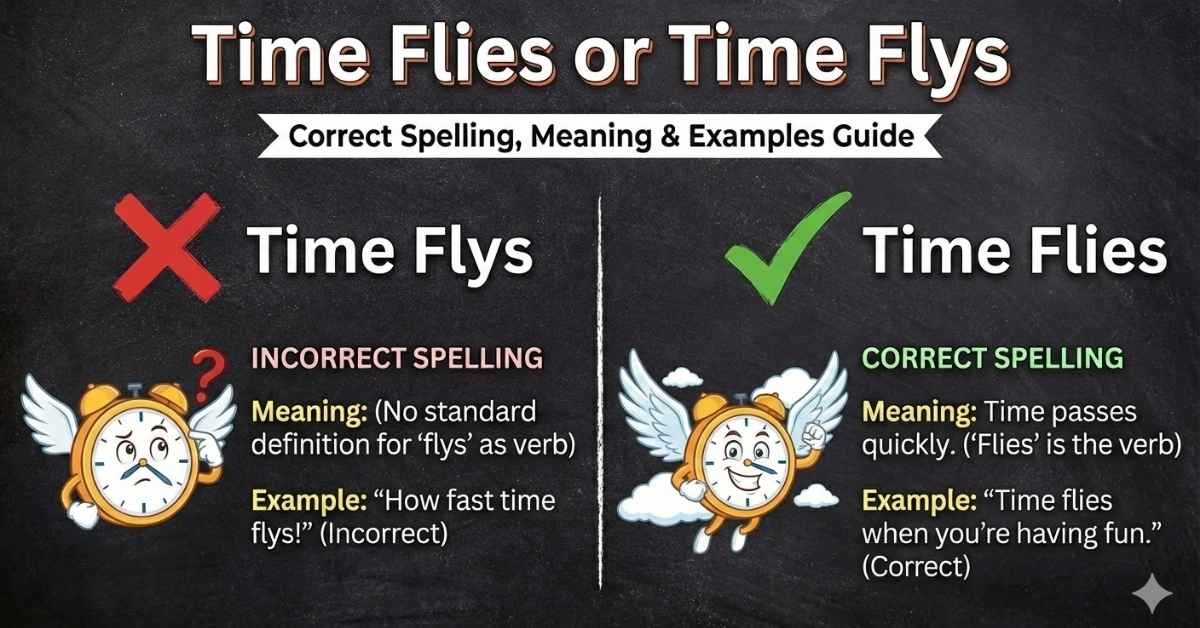
Time flies or time flys — if you’ve ever paused while typing this phrase, you’re not alone. This is one of the most common spelling and grammar confusions in everyday English, especially in emails, captions, headlines, and even professional writing.
Here’s the quick answer:
✅ “Time flies” is correct. ❌ “Time flys” is incorrect in standard English for this meaning.
But why is that true? What grammar rule makes it “flies” instead of “flys”? And is “flys” ever a real word?
In this guide, we’ll cover everything in a clear, human-friendly way: correct spelling, idiom meaning, grammar rules, examples, the phrase’s origin (tempus fugit), and practical memory tricks so you never get confused again.
Is It Time Flies or Time Flys? (Quick Answer)
Let’s answer the biggest question immediately:
✅ Correct: Time flies
This is the correct phrase when you mean:
- Time passes quickly
- Days feel like they go fast
- You can’t believe how quickly something ended
Correct example sentences:
- Time flies when you’re having fun.
- I can’t believe it’s already January — time flies.
- When you’re busy, time flies by.
❌ Incorrect: Time flys
“Time flys” is a misspelling in this meaning.
Incorrect:
Time flys when you’re having fun
✅ Corrected:
- Time flies when you’re having fun.
So yes, if you’re wondering:
Is it time flies or time flys? It is time flies ✅
Why “Time Flies” Is Correct (Grammar Rule Explained Simply)
Understanding this phrase becomes easy once you understand one simple rule: subject–verb agreement.
“Time” Is Singular → The Verb Must Match
In English grammar, the verb changes depending on the subject.
- Time = singular noun
- Singular nouns behave like he/she/it
- Therefore you must use the third-person singular form: flies
Think of it like this:
- Time flies
- It flies
This is the same pattern as:
- She runs
- He works
- It moves
So:
✅ Time flies ❌ Time fly
Fly → Flies Rule (Y → IES)
Now let’s tackle the spelling rule.
When a verb ends in consonant + y, and you need the third-person singular, you replace y with ies.
So:
| Base Verb | Third Person Singular |
|---|---|
| fly | flies |
| try | tries |
| cry | cries |
| carry | carries |
That’s why:
✅ fly → flies ❌ fly → flys
So the correct spelling is flies, not flys.
Subject–Verb Agreement (The Rule That Makes This Easy)
This is the hidden “boss rule” behind the phrase.
In present simple tense:
- I fly
- You fly
- We fly
- They fly
- He/She/It flies
And because time is singular, it behaves like it:
✅ Time flies.
Meaning of “Time Flies” (Idiom Meaning)
Now that the grammar is clear, let’s talk about meaning.
Literal Meaning vs Figurative Meaning
This phrase can be interpreted in two ways:
- Literal meaning (rare): Time physically flying like a bird or airplane (not realistic — mostly poetic writing)
- Figurative meaning (most common): Time passes quickly, often faster than expected
In everyday English, “time flies” is an idiom.
An idiom is an expression whose meaning is not literal—it’s understood culturally.
What “Time Flies” Really Means
When someone says “time flies,” they usually mean:
- “I didn’t realize time went by so fast.”
- “It feels like time moved quickly.”
- “I’m surprised how quickly this moment ended.”
It’s often used with feelings like:
- nostalgia
- surprise
- happiness
- sadness
- realization
“Time Flies When You’re Having Fun” Meaning
This is the most popular form of the phrase.
Time flies when you’re having fun means: When you enjoy something, you don’t notice time passing, so it feels faster.
Example:
- You start watching a movie at 7 PM…
- You check the clock and it’s already 10 PM That feeling is exactly what the idiom describes.
Examples — Correct vs Incorrect Usage
This is where most people improve quickly: seeing the phrase used naturally.
Correct Examples (Time Flies)
Here are real-life examples in everyday writing:
- Time flies when you’re surrounded by good people.
- I still remember our first meeting — time flies.
- It feels like yesterday, but time flies.
- Time flies by faster during holidays.
- When life gets busy, time flies.
- Can you believe we’re graduating already? Time flies!
- We’ve been friends for ten years — wow, time flies.
- The kids are growing up so fast — time flies.
- During travel, time flies because everything is exciting.
- In stressful weeks, time flies and also drags (both feelings can happen).
Incorrect Examples (Time Flys)
These are common mistakes:
Time flys when you’re busyWow time flys so fastTime flys by
✅ Correct versions:
- Time flies when you’re busy.
- Wow, time flies so fast.
- Time flies by.
“Flys” vs “Flies” (Not Just About the Idiom)
This is a very useful section because many people search:
- flys or flies
- flies or flys correct spelling
- is flys a word
Let’s clear it up properly.
What Does “Flies” Mean?
Flies can be either:
1) Verb (action)
It means: moves through the air.
- The bird flies high.
- The plane flies over the ocean.
2) Noun (plural)
It means: more than one insect called a fly.
- There are many flies near the trash.
- The kitchen has flies.
So flies is extremely common and correct.
Is “Flys” a Word?
This is interesting.
✅ Yes, but rarely — and not in this idiom
“Flys” can exist in certain contexts as a plural form of some specialized noun uses of “fly” (for example, in fishing flies), and sometimes as a spelling people use informally.
But in normal everyday grammar:
- flys is not the correct third-person verb form of fly
- the correct form is flies
So for the phrase we’re discussing:
✅ Time flies ❌ Time flys
Is “Time Flys” Ever Correct? Rare but Possible Contexts
In normal writing, time flys is incorrect.
But there are unusual exceptions where it might appear intentionally.
1) If “Time Flys” Is a Title or Brand Name
For example:
- A song title: Time Flys
- A username: @timeflys
- A product name: Time Flys Planner
In creative branding, spelling rules are often broken on purpose.
2) Creative Writing / Poetry
Some poets or writers might use “time flys” stylistically, but it’s not considered standard grammar.
“Time Flies By” or “Time Flies”? Which One Is Better?
Both are acceptable — they just feel slightly different.
Difference in Tone
| Phrase | Feel | Common Use |
|---|---|---|
| Time flies | short, punchy | conversation, captions |
| Time flies by | more descriptive | storytelling, reflective tone |
Examples
- Time flies when you’re having fun.
- Time flies by when you’re busy.
Both are correct. Choose based on style.
Origin of “Time Flies” (Tempus Fugit Meaning)
The idea behind “time flies” is very old.
Tempus Fugit Meaning
The phrase tempus fugit is a Latin expression that means:
“Time flees” or “time escapes.”
In other words: time runs away quickly and cannot be stopped.
That’s why English adopted similar expressions like:
- Time flies
- Time passes quickly
- Time slips away
- Time runs out
Where People Commonly Make This Mistake
This mistake is everywhere because the phrase is used everywhere.
Social Media Captions
People post emotional moments:
- “Can’t believe it’s been a year… time flys 🥺”
That looks normal to many readers, but it’s incorrect.
Emails and Professional Writing
This is where it can actually hurt credibility.
Example email:
“It was great working with you. Time flys!”
Even if your message is nice, the spelling mistake looks unprofessional.
Headlines, Blogs, Quotes
Writers use this phrase frequently, so it’s easy to type it fast without thinking.
READ MORE >>> Thumb In or Thumb Out: Meaning, Uses & Correct Thumb Position
Case Study: A Common Real-Life Example
Let’s look at a quick situation.
Case Study: Sarah writes a farewell email after working 2 years at a company. She writes: “Time flys! Thank you all.”
She sends it to the entire department.
What happened?
Nothing terrible — but two people privately pointed out the mistake. Sarah felt embarrassed.
The correct version:
✅ “Time flies! Thank you all.”
Lesson: Tiny grammar mistakes can affect professional impression, especially in formal writing.
Easy Ways to Remember the Correct Spelling (“Flies”)
Here are simple memory tricks that actually work.
Memory Trick #1: Time = It → It Flies
- Time = it
- It flies ✅ Time flies
Memory Trick #2: Flies Rhymes With Skies
Flies rhymes with:
- skies
- eyes
- tries
So you can remember:
Time flies under the skies.
Memory Trick #3: Think of “Flies” (Insects)
You already know the plural of fly is flies.
So your brain already recognizes:
- one fly
- two flies
That makes it easier to remember the correct spelling.
Quick Grammar Checklist (Fast & Simple)
Use this short checklist whenever you get confused:
- Time is singular → use flies
- Verb ends in consonant + y → change to ies
- Phrase is an idiom → keep the standard version
- “Flys” is almost always a mistake in this context
Common Questions (FAQ)
Is it time flies or time flys?
✅ It is time flies. ❌ “Time flys” is incorrect in standard English.
Why is it “flies” and not “flys”?
Because “time” is singular, so the verb must be third-person singular: fly → flies (y changes to ies).
What does “time flies” mean?
It means time passes quickly, especially when you are busy or enjoying something.
Is “time flys” grammatically correct?
No — not when using the idiom meaning “time passes quickly.”
Is “time flies by” correct?
Yes. Time flies by is correct and commonly used.
Can I use “time flys” in creative writing?
You can, but only if you intentionally use it as a title, brand name, or stylistic choice. In standard writing, avoid it.
Conclusion
Let’s wrap it up clearly:
✅ Time flies is correct ❌ Time flys is incorrect (in normal writing)
The reason is simple: time is singular, so the verb becomes flies, following both subject–verb agreement and the y → ies spelling rule.
So next time you’re writing a caption, email, quote, or blog post and wonder:
“Is it time flies or time flys?” You’ll know instantly: Time flies.
“The days are long, but the years are short.” And yes… time flies.